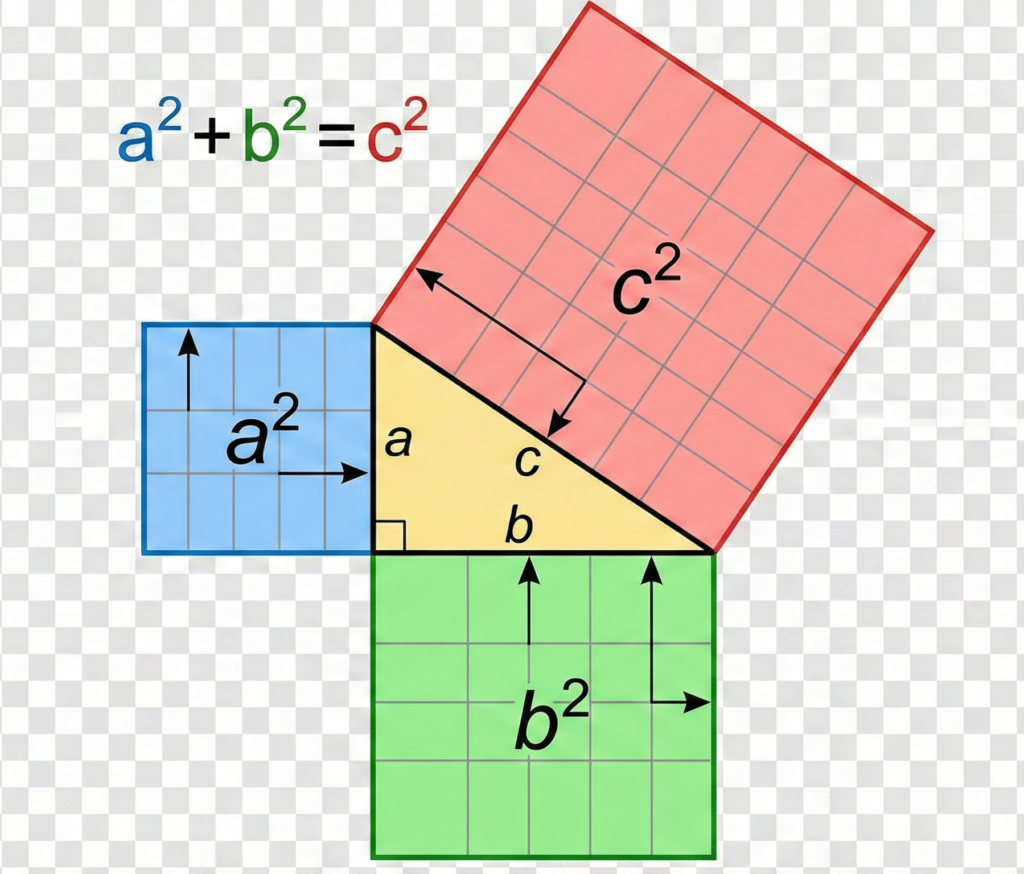
This Pythagorean Theorem Calculator will help you find the sides of a triangle without wasting your time.
[Image of right triangle pythagoras theorem diagram]
📐 Pythagorean Theorem Calculator
Resulting Side Length:
0
To calculate the hypotenuse of a triangle or calculate the side of a triangle, we can use the Pythagorean theorem formula.
What is Pythagoras / Pythagorean?
In engineering, pythagoras / pythagorean theorem is the most used basic foundation. This formula describes the fundamental relationship between the three sides of a triangle.
The name of the Pythagorean formula is taken from the name of an ancient Greek mathematician, Pythagoras, who first discovered this formula.
The main principle is simple:
‘In any right triangle, the square of the length of the hypotenuse is equal to the sum of the squares of the lengths of both sides of its right.’
Learning The Pythagorean Theorem Formula
📐 The Pythagorean Theorem
a2 + b2 = c2
C (Hypotenuse Side)c = √(a² + b²)
A (Base Side)a = √(c² – b²)
B (Upright Side)b = √(c² – a²)
Daily Case of Pythagorean Theorem Examples
🚧 Project: Wheelchair Ramp Sizing
A handyman needs to build a wheelchair ramp to access a stage floor that is 3 meters high. With 4 meters of available floor space for the base, what is the required length of the sloping board?
Base (a)4 Meters
Rise/Height (b)3 Meters
Equationc = √(a² + b²)
Substitution√(4² + 3²) = √(16 + 9)
EngPocket Team Recommendation:
Minimum board length required:
5.0 Meters
Master the Pythagorean Theorem. Academic Exercises
Let’s look at some common variations often found in school exams.
📖 Geometry Side Calculation Practice
📐 Example 1: Calculating the Vertical Side (b)
Known Data:Hypotenuse (c) = 13 cm, Base (a) = 5 cm
Formula:b = √(c² – a²)
b = √(13² – 5²)
b = √(169 – 25)
b = √(144)
Final Result: The vertical height of the triangle is 12 cm.
📏 Example 2: Calculating the Base Side (a)
Known Data:Hypotenuse (c) = 10 m, Vertical Side (b) = 8 m
Formula:a = √(c² – b²)
a = √(10² – 8²)
a = √(100 – 64)
a = √(36)
Final Result: The length of the triangle’s base is 6 meters.
Real Life Applications. Pythagorean Theorem in Engineering & Construction
In the field, the Pythagorean theorem is more than just numbers on paper. At EngPocket, we often call it the lifesaving formula for ensuring structural precision. Here are some practical cases:
1 Checking the Squareness of a Room
This is the most legendary trick for builders. When starting to build the foundation or installing tiles, we must ensure the corners are exactly 90 degrees. We call this the 3-4-5 technique.
Case: If you measure 3 meters along Wall A and 4 meters along Wall B, the diagonal distance between those two points MUST be exactly 5 meters.
Function: If the distance is not exactly 5 meters (for example, 5.2 meters), your room is out of square. Repair it quickly before it is too late. This is crucial so that when you install floor tiles, the cuts aren’t crooked at the edges.
2 Calculating Cable Tray Offset Lengths
In electrical installations, we sometimes need to pull cables diagonally between two points that are blocked by the building’s columns.
Case: The EngPocket team needs to run cables from the 1st floor to a mezzanine. The mezzanine height is 4 meters, and the horizontal distance from the panel to the mezzanine area is 6 meters.
With this calculation, our team can estimate cable procurement and cable tray length with high accuracy.
3 Calculating Roof Rafter or Purlin Length
For roofing contractors working with light steel or timber, the Pythagorean theorem is used to calculate the diagonal length of a roof based on the building width and the ridge height.
Case: A house under construction is 8 meters wide. This tells us that the base of the roof triangle is half of that, which is 4 meters. The desired peak height is 3 meters. What is the diagonal length of the roof?
This helps us order metal roofing or shingles accurately, preventing material waste or shortages.
4 Ladder Safety & Positioning
💡 FYI: I don’t think a single human ever does this calculation in practice. You can skip this part if you are busy. But I will write this anyway—in case one day someone needs this, then I will be the savior for them 😀
When setting up extension ladders or permanent stairs, the slope ratio is vital for safety.
Case: We need to climb a wall that is 4 meters high. To prevent the ladder from slipping, the base should be placed 1.5 meters away from the wall. What is the minimum ladder length required?
As field practitioners, we don’t always need a calculator if we memorize Pythagorean Triples. These are combinations of three whole numbers that are guaranteed to form a right-angled triangle.
Like the 3-4-5 ratio we discussed earlier, we just need to memorize them. For students, this isn’t “cheating”—it’s a smart trick instead. You can use it too!