Pipe Velocity Calculator
Hello Engpocket friends! Have you ever felt that calculating the speed of water in the pipes you installed slows you down for maybe 15 minutes or even thought about the pipe velocity in your house pipe installation?
No worries anymore, because Engpocket team just developed a pipe velocity calculator and we are happy if this calculator can make you save your time.
Pipe Velocity Calculator
What is Pipe Velocity?
Understanding Pipe Velocity
In fluid mechanics and plumbing design, pipe Velocity is the speed at which water travels through a pipe. It is different from flow rate (which is the volume of water).
Monitoring pipe velocity is critical for two reasons:
It can cause noise (water hammer), vibration, and pipe erosion.
It can cause dirt settling at the bottom of the pipe and stagnant water issues.
Safe Design Standard Typically 1.0 to 2.0 m/s for distribution systems.
This calculator is very important and will help you determine the velocity based on the flow rate and pipe diameter to ensure your system runs in the safe standard.
How to Use the Pipe Velocity Calculator
Steps of using velocity calculator
Enter the flow rate and select the unit: m³/h, Liter/sec, or Liter/min.
Enter the internal pipe diameter in millimeters (mm).
Click calculate to see the velocity in meters per second (m/s).
Pipe Velocity Formula
Continuity Equation of Fluids
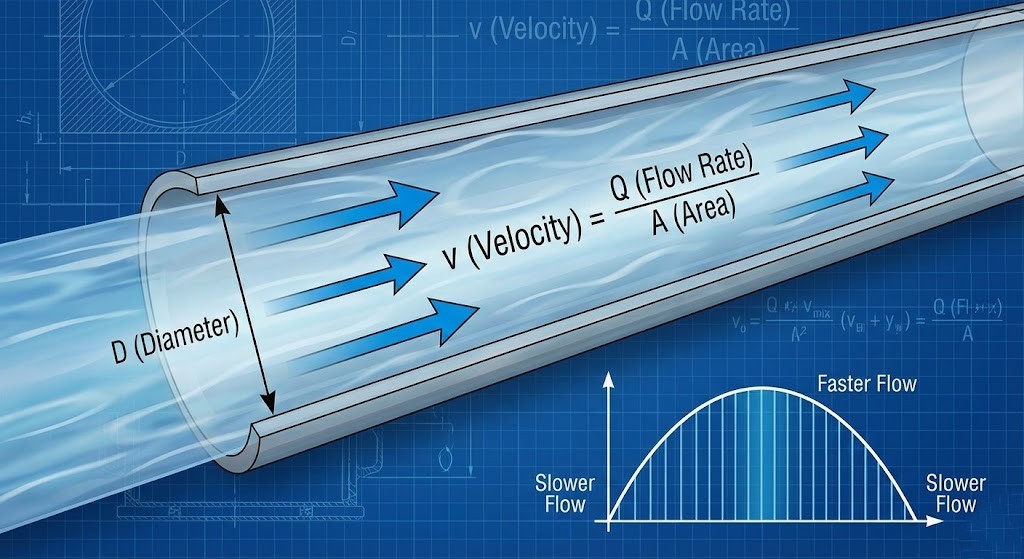
The calculation is based on the continuity equation of fluids:
Velocity (Speed of fluid in m/s)
Flow Rate (Volume per second in m³/s)
Cross-sectional Area of the pipe (m²)
To find the area (A) of a pipe, we use:
Example Calculation
Case Study: Is the Velocity Safe?
A water pump in Engpocket’s project delivers 50 m³/h of water through a 4 inch pipe with the internal diameter equals to 100 mm.
Diameter = 100 mm = 0.1 m | Radius = 0.05 m
Formula: v = Q / A
The velocity is 1.76 m/s.
Since this is between 0.6 and 2.5 m/s, the velocity is considered safe and good. The engpocket engineer has done a good job.
Flow Velocity and Pump’s Electricity Bill
Velocity & Frictional Resistance
Did you know that the speed of water inside your pipes is directly tied to head loss and frictional resistance?
In simple terms: the faster the water flows, the more its “scrapes” against the internal walls of the pipe, creating energy-robbing friction.
When this friction increases, our water pump is forced to work significantly harder to push the fluid to its destination. This extra effort affected directly into higher electricity consumption and a more expensive utility bill.
Selecting pipes that are too small in diameter to save on initial material costs. However, this causes the flow velocity to skyrocket, leading to intense friction that can cause the pump to overheat or fail prematurely.
For the long run, the costs of operation and repairs will far exceed the money saved on smaller pipes.