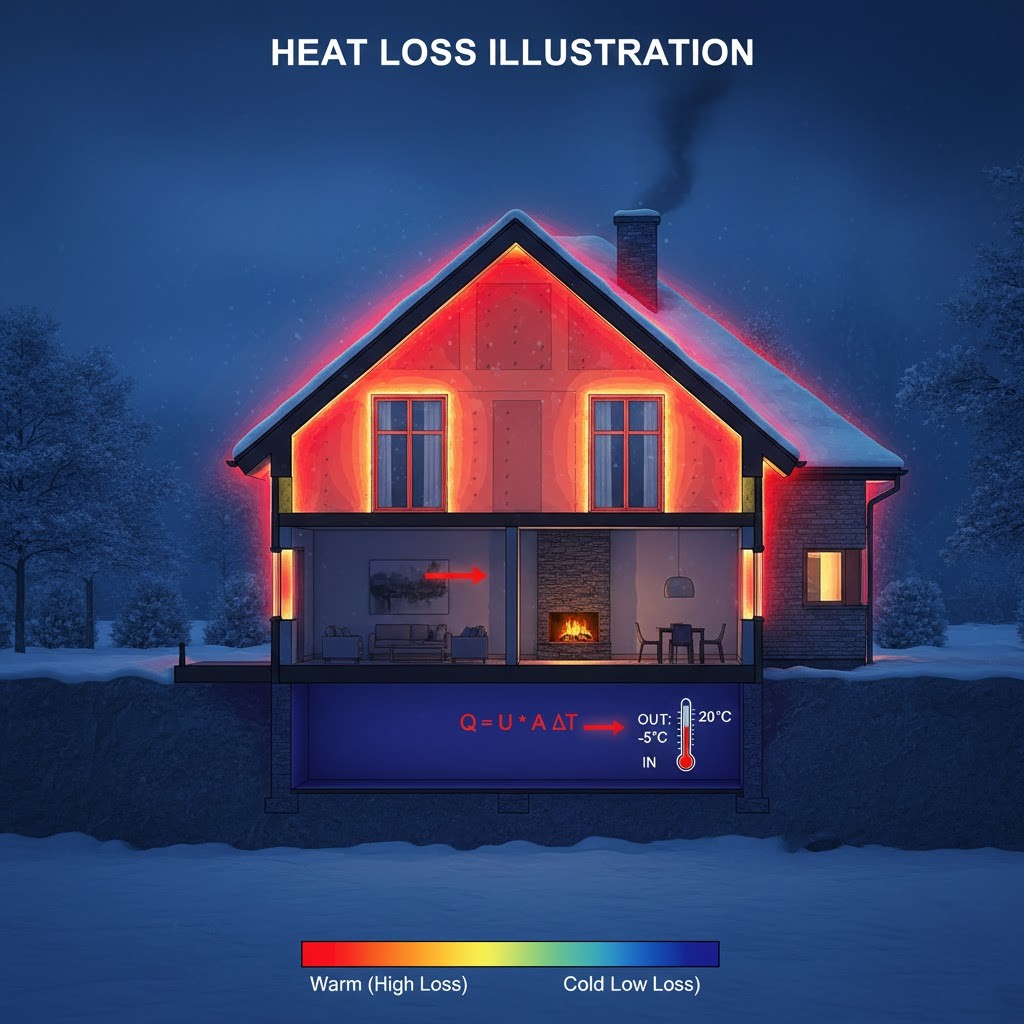
Heat Loss Calculator
This heat loss calculator is very important for HVAC & ME contractors.
Heat Loss Calculator
*Note: This calculation uses a simplified building envelope method (Walls + Ceiling). Floor heat loss and air infiltration are not included.
How to Use the Heat Loss Calculator?
Heat Loss Calculation Guide
To determine the heating requirements for a building, follow these input steps in our calculator:
Enter room dimension (length, width, and height).
Enter the desired indoor temperature (Δ T) and the lowest outdoor ambient temperature.
This represents the thermal transmittance. Below are the standard values:
| Insulation Type | U-Value (W/m²K) |
|---|---|
| Well Insulated | 0.1 – 0.3 |
| Standard Wall | 0.5 – 1.0 |
| Poorly Insulated (Single brick) | 1.5 – 2.5 |
The calculator will provide the heat loss in Watts and BTU/h as the result.
Definition of Heat Loss
What is heat loss? Heat loss is the measurement of total heat transfer from inside to the outside of a building.
Understanding this value is very important for HVAC engineers and contractors to ensure proper sizing of the heating systems, set the comfort temperature during winter and applying energy efficiency.
Heat Loss Formula
Heat Loss Formula
Example of Heat Lost Calculation
Case Study: Heat Loss Calculation
You can try to calculate manually first, then use the heat loss calculator to ensure that both calculation were right.
A room has a total wall area of 40 m² with a U-Value of 1.5 W/m²K. The indoor temperature is 22°C, and the outdoor temperature is 2°C. Calculate the heat loss:
U = 1.5 W/m²K
ΔT = 22°C – 2°C = 20°C
Q = 60 × 20
Answer: The total heat loss is 1,200 Watts.
Beyond the Calculator. Air infiltration Heat Loss
Understanding Air Infiltration
While our heat loss calculator above provides the transmission heat loss (heat moving through solid materials like walls and glass), HVAC contractors and engineers must also calculate Air Infiltration.
For older and poorly sealed buildings, air infiltration can account for more than 30% of the total heat loss. When calculating for a drafty building, we should add a ventilation heat loss margin to the result above.
Why Accurate Calculation Prevents Short Cycling
HVAC Warning: The Risk of Oversizing
A common mistake in the HVAC industry is “oversizing” the system simply to create a safety margin. We might think installing a 10-kW heater in a room that only loses 5 kW of heat is a good safety margin. However, this causes a short cycling phenomenon.
Short cycling phenomenon occurs when a heating unit is too powerful for the space. It heats the room to the target temperature rapidly and then shuts off. Because the walls haven’t had time to absorb the heat or what we call thermal soak, the room cools down quickly, forcing the unit to turn on again.
This rapid On-Off cycle causes three major problems:
The compressor or burner wears out significantly faster during startup than during continuous running.
Systems are least efficient during the startup phase.
It creates noticeable temperature swings (hot blasts followed by cold drafts) rather than a steady warmth.