Force Calculator, calculate force f=ma
This calculator helps engpocket friends to determine force, mass, or acceleration using Newton’s Second Law of Motion, which says that force acting on an object is equal to the mass of that object multiplied by its acceleration.
🚀 Force Calculator (F = m × a)
What is force & Newton’s Law?
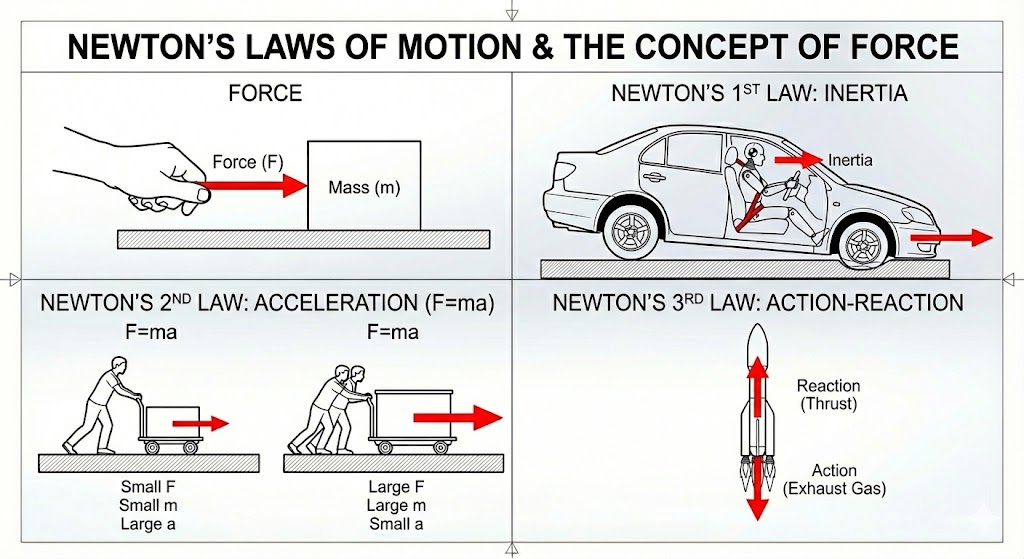
Force is a vector quantity that can change the motion of an object or cause deformation. In the International System of Units (SI), force is measured in Newtons (N).
Why we call Newton? Why we used it?
Sir Isaac Newton (1642–1727) was an English mathematician, physicist, astronomer, and author who is famously recognized as one of the most influential scientists and a key figure in the scientific revolution.
We use Newton’s Laws because it acts as the operating system of the physical world for engineers and scientists. Even though Albert Einstein later developed the Theory of Relativity for extreme speeds (near light speed), Newton’s laws still remain the standard for 99.9% of engineering tasks on this human earth.
Our force calculator also used Newton’s Laws as it based.
Key Concepts of this force calculator post:
- Unit of force: The SI unit is the newton (N). One newton is the force required to accelerate a mass of 1 kg at a rate of 1 m/s².
- Vector Nature: Force has magnitude and direction, making it a vector quantity.
- Net force: When multiple forces act on an object, the net force is the vector sum of all individual forces.
- Weight vs Mass: Mass is the amount of matter in an object (kg), while weight is the force of gravity acting on that mass. On Earth, Weight = Mass × 9.8 m/s².
Force / Newton’s Law formula
Want to know how the force calculator works? It used this formula:
Newton’s Second Law
- F = Force (N)
- m = Mass (kg)
- a = Acceleration (m/s²)
Example problem
A warehouse worker pushes a cart with a mass of 50 kg. If the cart accelerates at of 2 m/s², how much force is the worker applying?
Note: We can use the force calculator above or use the following manual calculation:
Mass = 50 kg
Acceleration (a) = 2 m/s²
So, the calculation is:
Now, we know that the worker is doing / applying a 100 Newton force.
Why does force matters in engineering field practice?
We often think of force only when something is moving fast, like a car or a falling object. But, for engineers, understanding force is very important even for things that are supposed to stay still or not moving at all.
Think about a cargo elevator in a warehouse. When the elevator starts to move upward, it doesn’t just need enough power to hold its own weight, instead, it needs extra force to accelerate that weight from a standstill.
If engpocket friends don’t use a force calculator to find the exact Newtons required during that initial execution or acceleration phase, you might undersize your cables or the electric motor.
This is where many projects go wrong, they design for the weight (static force) but forget to design about the acceleration (dynamic force).
This is the end of our force calculator & Newton’s Law post.
We also provide you a kg to metric tons calculator which you can use on this link. Enjoy!