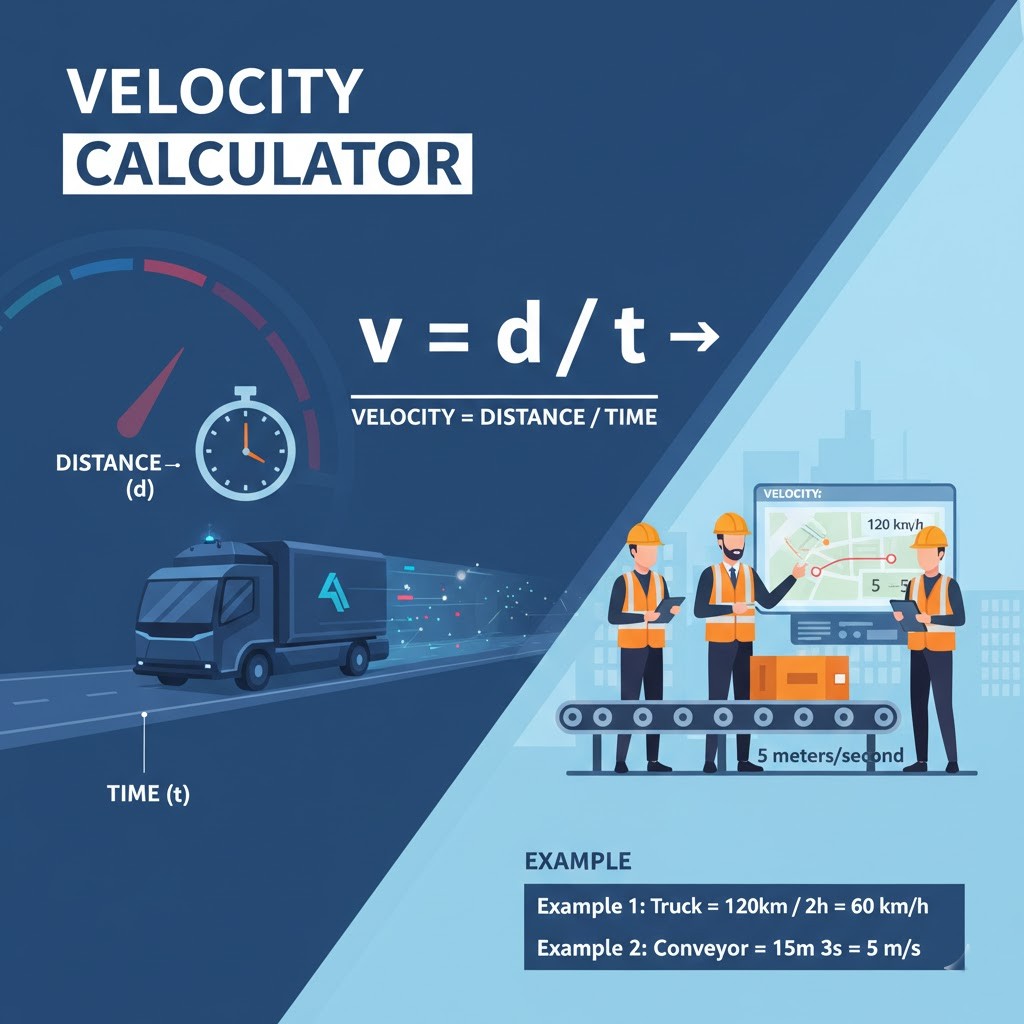
Velocity Calculator, Measuring Rate of Displacement, Time, Distance

Velocity calculator

Hello engpocket friends, knowing how fast an object moves from 1 point to another point is crucial. Whether we are tracking a delivery truck or calibrating the speed of a conveyor belt line, velocity calculations ensure efficiency and safety. This velocity calculator helps instantly determine the rate of displacement based on distance and time.

Velocity Calculator

Result: —

What is velocity?

Velocity describes the rate of how fast an object changes its position. Velocity and speed are similer, but velocity technically includes direction. However, for most general calculation purposes (calculating average speed).

Velocity formula

This velocity formula is how the velocity calculator works:

Calculate velocity formula
Formula: v=dt\text{Formula: } v = \frac{d}{t}
Where: v=Velocity,d=Distance,t=Time\text{Where: } v = \text{Velocity}, d = \text{Distance}, t = \text{Time}

Calculate distance formula
Formula: d=vร—t\text{Formula: } d = v \times t

Calculate times formula
Formula: t=dv\text{Formula: } t = \frac{d}{v}

Velocity calculation case example

velocity calculator

A machine part moves 20 meters along a belt in 4 seconds. Calculate the velocity:

Step 1: 20รท4\text{Step 1: } 20 \div 4
Result: 5 meters/second\text{Result: 5 meters/second}

Real life applications and calculations of velocity

For our engpocket friends who was working in the field, understanding how to calculate velocity manually is just as important as using any digital tools.

While our velocity calculator can provide results in seconds, having mathematical intuition helps us verify whether a machine is running according to specifications or if there is an anomaly in the system.

Often, the data we have on-site isn’t presented simply as distance and time but rather as operational situations that require troubleshooting from professional manpower.

Let’s look at some case examples in factory automation. Imagine you are commissioning a new assembly line. A sensor is placed at the end of a conveyor belt that is 12 meters long.

You need to ensure the drive motor is calibrated correctly so products do not pile up. If a box takes exactly 4 seconds to move from the upstream end to the downstream end, what is its velocity?

Without needing complex formulas, we simply divide the travel distance by the time. In this case, 12 meters divided by 4 seconds results in an operational velocity of 3 meters per second (m/s).

If the machine specifications require a speed of 3.5 m/s, you know that the Variable Frequency Drive (VFD) settings on the motor need to be increased. This is where the velocity calculator comes in handy to perform quick verification after you have re-adjusted the motor.

A second common case occurs in logistics or civil engineering. Suppose a fleet manager needs to calculate the delivery efficiency of trucks between cities. A truck departs from warehouse CHICAGO to Warehouse DALLAS, which are 240 kilometers apart.

Due to traffic conditions and rest stops, the trip takes a total of 6 hours. To determine the average performance (average velocity), we divide 240 km by 6 hours, resulting in 40 km/h. This figure is crucial not just for arranging schedule, but also for estimating long term fuel consumption.

Move on to HVAC (Heating, Ventilation, and Air Conditioning) systems, airflow velocity is a critical parameter. Air moving too slowly will not cool the room effectively, while air moving too fast will generate noise.

If a technician measures that air travels through a 10-meter duct in 2 seconds, the velocity is 5 m/s. If comfort standards require a maximum of 4 m/s to prevent noise in an office area, the technician must lower the fan speed.

Finally, in plumbing maintenance, excessive water velocity can cause water hammer, a pressure surge or shock wave when a valve is closed suddenly.

If water flows 50 meters in 25 seconds (a velocity of 2 m/s), this is usually within safe limits. However, if the calculation shows figures above 3 m/s, the risk of pipe damage increases drastically.

By using a velocity calculator, you can quickly convert and compare these figures against industry safety standards (like ISO or local codes) without need to scribble on paper at a busy project situation like engpocket’s project.

Now you can calculate velocity faster than before. If you are an electrician, and you want to use our ground wire size calculator, feel free to visit this link.

Leave a Comment