Flow Rate Calculator
Hello again Engpocket friends, this is the flow rate calculator post that we promised you. This can be the complement of our pipe velocity calculator. Before calculating the pipe velocity, we must know the flow rate, either we calculate it or we got the information from the field.
Flow Rate Calculator
What is a Flow Rate?
Introduction to Volumetric Flow Rate
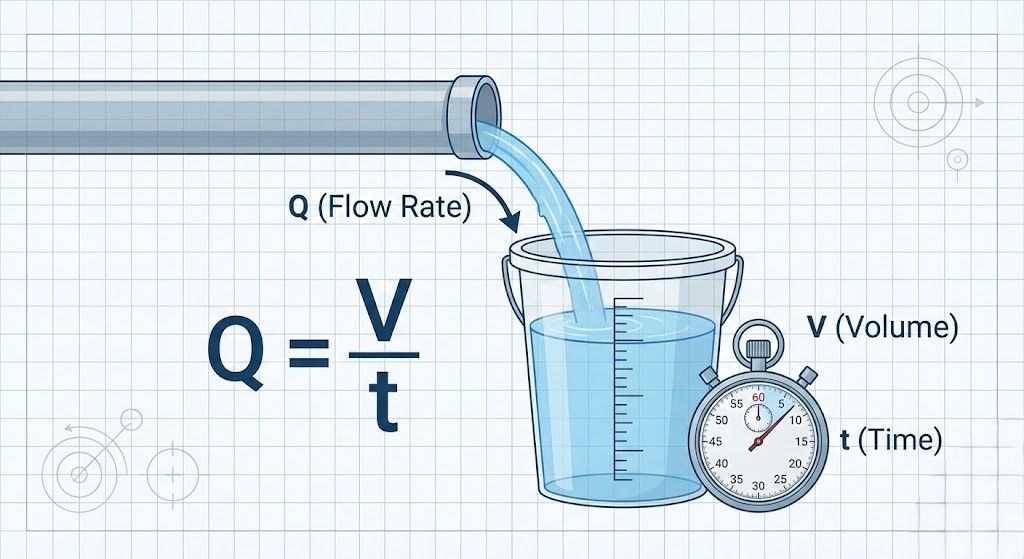
Volumetric flow rate (often written as Q) is the volume of fluid that passes per unit of time. Different from velocity (which measures speed in distance per second), flow rate measures the capacity or quantity of the fluid moving through the system.
Flow rate Formula and Example of Flow Rate Calculation
Example of Flow Rate Calculation
The fundamental definition of flow rate uses the volume-over-time equation:
A technician wants to measure the flow rate of a water pump. He uses a 200 Liter drum. The pump fills the drum until full in just 50 seconds. What is the flow rate in m³/h?
ANSWER The flow rate of the pump is 14.4 cubic meters per hour (m³/h).
Way Use Flow Rate Calculator on Site and How to Use the Bucket Test
Field Method: The Bucket Test
EngPocket friends, you might be asking, how can we get the volume and time data if I do not have a good digital flow meter? The answer is simple and often used by senior engineers in the field, we call it The Bucket Test.
Imagine you want to measure the flow rate of a garden tap or a well pump output. You do not need to cut the pipe to install a sensor. Just grab an old paint bucket or a jerrycan that you know the exact volume of (for example, 20 Liters).
If that 20 Liter bucket is full in 15 Seconds, you just need to input those numbers into our flow rate calculator above.
This tool will instantly tell you the flow rate in Liters per minute or cubic meters per hour. This method is accurate enough for domestic needs or quick verification on a project site.
Why is My Flow Rate Low? (Troubleshooting problem)
Why is my Flow Rate low?
After using the flow rate calculator, sometimes the result makes us disappointed because the number is far below the pump specification. If our flow rate is low, there are usually three main suspects:
Often there is dirt or limescale building up in the tap aerator or inside the pump impeller.
If we use a big pump but the pipe is as small as a straw, the water flow will be choked (high friction loss), making the flow rate at the end of the pipe very weak.
Remember, the higher the pump has to push the water up (for example to a roof tank on the 4th floor), the smaller the flow rate becomes.
“Use the result from this calculator as your baseline data to investigate these problems.”
10 Flow Rate Practice Problems
Volumetric Flow Rate Challenge
To sharpen your engineering logic, EngPocket friends, try to solve these 10 simple cases on a scratch paper. After you find the answers, please validate them using our flow rate calculator to see if your manual calculation is precise.