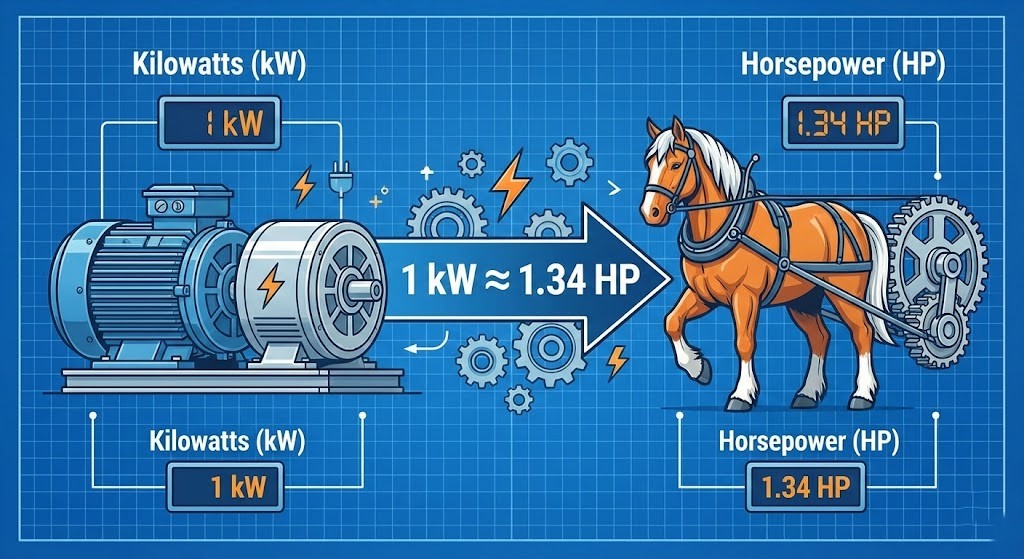
Convert kW to HP
Power is one of the very important fundamental measurements. However, different regions and industries use different standards. There are some units of power, two of them are kW and HP. The international system of units (SI) uses kilowatts (kW), the imperial system and mechanical industries use horsepower (HP).
Converting between these two units (convert kw to hp) is a daily task for engineers, whether you are sizing an electric motor, calculating engine output, or selecting an air conditioning compressor. This post will explain the definitions, the conversion formula, and provide a kW to HP calculator.
kW to HP Converter
With Step-by-Step Calculation
Understanding kW and HP
Power Units: Kilowatt & Horsepower
Kilowatt is the standard unit of power in the SI. It is equal to 1,000 watts. It is universally used in electrical engineering to measure the power consumption of appliances, motors, and the output of generators.
Horsepower (HP) is a unit of power adopted by James Watt to compare the output of steam engines with the power of draft horses. There are 2 types:
Common in the US and UK.
1 HP ≈ 745.7 WattsCommon in Europe and Asia.
1 HP ≈ 735.5 Watts“Use our calculator above to switch between kW and HP instantly for your technical specifications.”
kW to HP Conversion Formula
Rumus Konversi / Formula:
- P(HP) = Power in Horsepower (HP)
- P(kW) = Power in Kilowatts (kW)
- 1.341 = Conversion Constant
Calculate kW to HP Example
Conversion: kW to Horsepower
We have an electric motor, and the power output is 15 kW. What is the equivalent power in horsepower?
Given: P = 15 kW
Final Equivalent: The motor is 20 HP if we convert to horsepower.
Table of Kilowatts to HP Conversion
Quick Conversion: kW to HP
Type any value above for instant result
| Power (kW) | Power (HP) | Common Application |
|---|
The Efficiency GAP
This will be about the input versus the output. Be careful when engpocket friends read the nameplate while convert kw to hp. There is a hidden trap called efficiency. Usually, Horsepower (HP) refers to the mechanical output power at the shaft (the work the motor actually does).
On the other side, Kilowatt (kW) often refers to the electrical input power, the energy consumed from the grid by the motor. If we simply convert kW to HP using our calculator, we will get the theoretical output.
However, real life motors are never 100% efficient. To size our generator or cable correctly, we must divide the result by the motor’s efficiency (often 0.8 to 0.9). If we ignore this efficiency gap, our breaker might trip because the motor draws more current than our calculation result.
Regional Trap. Metric vs. Mechanical HP
Peringatan: Perbedaan Standar HP
Buying equipment from different countries can be difficult and tricky. If we order a 500 HP compressor from Germany, it is likely rated in Metric HP (also known as PS or Pferdestärke).
But, if we buy the same 500 HP compressor from USA, it is rated in Mechanical HP. Even if the numbers look the same, Mechanical HP is larger than Metric HP.
For small pumps, the difference is negligible. But for large industrial engines, this 1.4% discrepancy can lead to overloading or mismatching with the driven equipment.
Why Modern EVs Use kW?
In the age of electric vehicles (EVs), the term Horsepower is slowly becoming not popular anymore. Why? Because an electric motor’s output can be more accurate if measured in electrical units.
Unlike the internal combustion engines which have complex torque curves and transmission losses, an electric motor delivers power linearly. Using kW provides a more precise and direct measurement of the vehicle’s performance.
That is why in many modern car specifications, we will see the engine rated in kW first, with HP only in brackets for traditional reference.