About Galvanized Steel Sheet Thickness, Sheet Metal Gauge, and The Calculator
With 18 years of experience in the HVAC & ME industry, the EngPocket team considers ducting to be the very core of our work.
One of the most common questions we get is: How thick should the galvanized steel sheet be for a given supply or return duct?
In this post, we will dive into the details and provide you with a handy calculator to determine the exact ducting thickness you need.
Gauge Calculator
Standard: SMACNA HVAC Duct Construction (Low-Med Pressure)
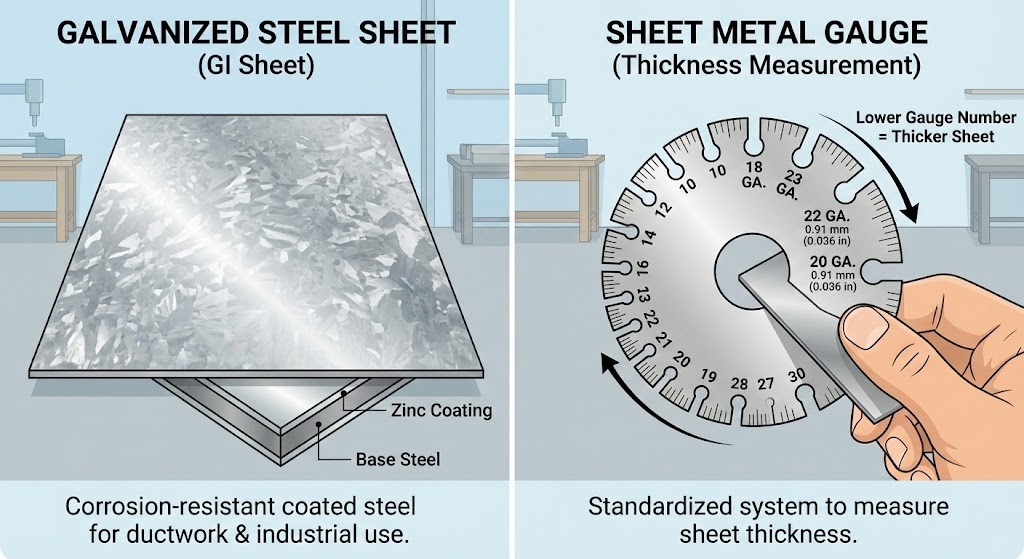
Let me introduce you to galvanized steel sheet.
Galvanized steel refers to steel sheets coated with a protective layer of zinc. For HVAC ductwork, these sheets typically come in various thicknesses, most commonly ranging from 0.4 mm to 1.2 mm.
The required thickness for a duct installation is never determined arbitrarily. Instead, it follows a strict international HVAC standard set by SMACNA (Sheet Metal and Air Conditioning Contractors' National Association).
However, because the original SMACNA guidelines are based on the imperial system, their tables use inches and Gauge (Ga) units rather than millimeters.
Galvanized Steel Sheet Metal Gauge Table
Here is a table of galvanized steel sheet metal gauge thickness standards according to SMACNA for your reference. We have already converted to mm units to help you compare:
| Longest side Ducting (mm) | Thickness (mm) | US Gauge (Ga) |
| 0-300 mm | 0.5 mm | Ga 26 |
| 301-750 mm | 0.6 mm | Ga 24 |
| 751-1000 mm | 0.8 mm | Ga 22 |
| 1001-1500 mm | 1 mm | Ga 20 |
| >1500 mm | 1,2 mm | Ga 18 |
Well, the thickness of the ducting is determined from the longest side of the ducting size.
Case Example of Selecting the Right Duct Gauge
The Art of Fabrication: Precision Cutting & Jointing Techniques
Understanding the correct sheet gauge is only the first step in the manufacturing process.
Our 18 years of field experience have proven that the primary enemy of quality is not thin material, but also imprecise fabrication, jointing and lack of sealant.
The most common issue with manual cutting of galvanized steel sheets is about precision, often resulting in a sheet that is not perfectly rectangular (parallelogram shape).
If the sheet is not cut squarely, even if the deviation is just 2-3 mm, the impact is fatal during the bending/folding process. The result? The duct will be "twisted" or "racked" when assembled. A twisted duct is not only visually unappealing, but it also causes the inter-flange connections to misalign, leading to significant air leakage.
• If the diagonals are equal: Your sheet is perfectly square (90° angles).
• If diagonals differ: Adjust your marking immediately. Do not cut.
Selecting the correct connection system is important for structural integrity. Do not use the same joint for all duct sizes. Simply: Different size, different joint.
Characteristics: This is a low-profile connection that saves material. However, it lacks the rigidity required for larger spans.
Standard: Widely accepted by SMACNA for low-pressure residential and light commercial systems.
Characteristics: The flange is roll-formed directly from the galvanized sheet, creating a rigid frame. It is better than the conventional angle iron method in terms of speed, neatness, and air tightness.
Standard: Essential for medium-pressure systems to prevent duct deformation.
Regardless of the joint type (S & Drive or TDF), sealant is a must.
Apply a high-quality HVAC silicone or mastic sealant at every corner (specifically around the corner pieces or clips) before bolting the flanges together.
A leak as small as a pinhole can drastically drop the static pressure (ESP), forcing your fan to work harder and reducing the cooling efficiency of the whole system.