Lateral Surface Area of a Cylinder and Cylinder Volume Calculator
Inspired by our daily engineering challenges, the Engpocket team created this advanced cylinder calculator to help you get accurate results faster and skip the manual math.
🛢️ Cylinder Master Calculator
Calculate Standardized Area (m²) & Volume (Liters/m³)
Definition of Lateral Surface Area of a Cylinder
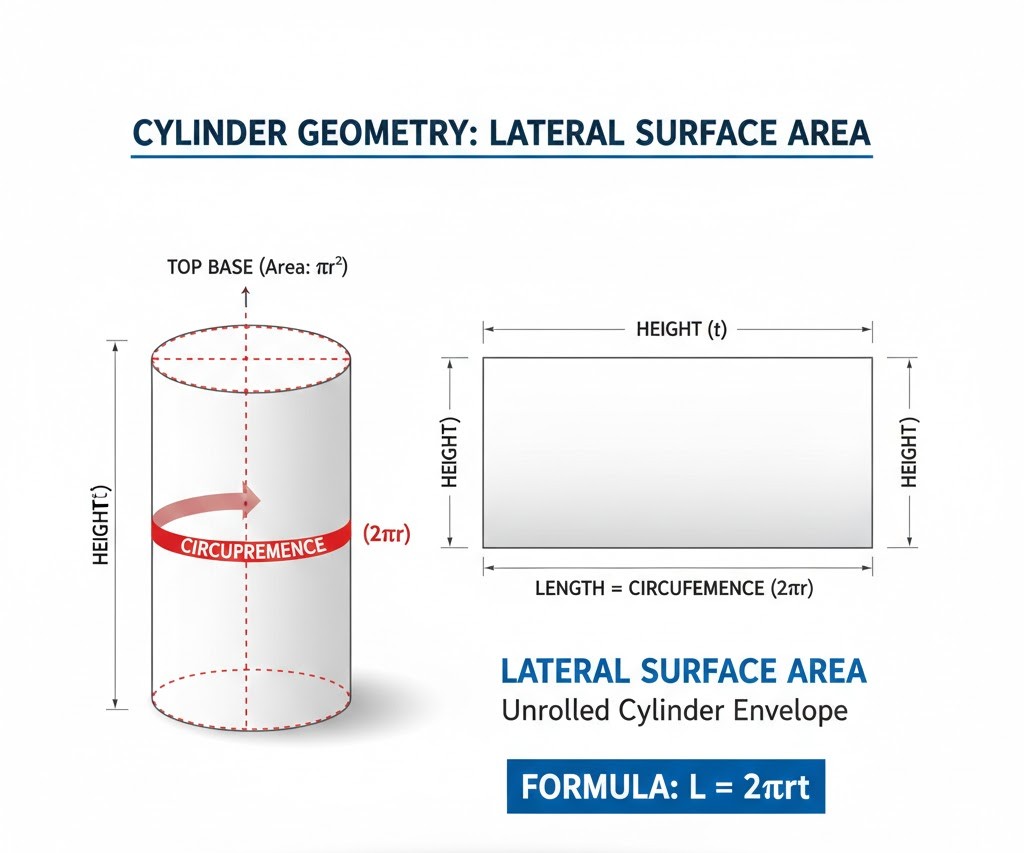
A tube or cylinder consists of three parts, namely the top lid, bottom base, and blanket. The lateral surface area of the cylinder is the surface area that envelops the tube, excluding the lid and base.
A simple analogy, imagine a can of condensed milk. The part of the paper label that circles around the body of the can is called the tube surface blanket.
Understanding Cylinder Volume
Cylinder volume represents the total amount of space contained within a cylindrical object. In everyday terms, it answers the question: "What is the maximum capacity this cylinder can hold?"
Cylinder Lateral Surface Area and Volume Formulas
Cylinder lateral surface area formula when the radius is known:
Cylinder lateral surface area formula when the diameter is known:
Cylinder Volume Formula:
Based on fundamental engineering logic, the volume or capacity of an object is calculated by multiplying its base area by its height. Since a cylinder’s base is always circular, we apply the circular area formula (π x r²) and multiply it by the cylinder's height (h).
Example Problems
- Tank diameter = 1 meter
- Tank height = 1.5 meters
The Uniqueness of Calculating Pipe or Round Duct Insulation Area
For cylinder volumes or cylindrical objects, all calculation cases are the same. But as an HVAC MEP contractor, the Engpocket team wants to share a little about the unique case of calculating the insulation area for pipes or round ducts.
Many estimators make a fatal mistake by only calculating the surface area of the pipe or round duct itself, just like the Engpocket team and I used to do. In reality, when wrapped in thick insulation, the diameter will increase. The surface area of the insulation (outer skin) is definitely larger than the area of the pipe or duct inside it.
Here are the formulas and a case study:
When wrapping a pipe or ducting, the insulation thickness adds to the outer dimensions of the object. Since the insulation wraps around entirely, its thickness attaches to both sides (top-bottom or left-right). Therefore, we cannot directly use the original pipe diameter.
Phase 1: Find Total Diameter (Dtotal)
Phase 2: Calculate Insulation Area (Lateral Area Adaptation)
📋 Field Case Study
The EngPocket team needs to wrap a 300 mm diameter round duct with 50 mm thick XLPE insulation. The length of the ducting run is 10 meters. How many square meters of XLPE insulation material must be prepared for the field?
Step 1: Calculate Total Diameter (Dtotal)Dtotal = 300 mm + 100 mm
Dtotal = 400 mm
*Since the area formula uses meters, convert 400 mm to 0.4 meters.
Step 2: Calculate Area Requirement (L)L = 1.256 x 10
L = 12.56 m²
Therefore, the 50 mm thick XLPE insulation area needed by the team is 12.56 m².