Chiller calculation
Hello engpocket friend, anyone of you worked in HVAC ME Contractor or in industrial?
❄️ Chiller GPM Calculator
0 GPM
…
Based on ARI standard water specific heat.
You must know and familiar with chiller units. In this post, we will show you how calculate chiller GPM and also provide you the calculator.
The relationship between chiller & GPM
Calculating GPM (Gallons Per Minute) is a method to determine the required water flow rate to transfer heat effectively in a chiller water system. Based on our calculator, here is an explanation of what is actually being calculated:
Heat Transfer Capacity
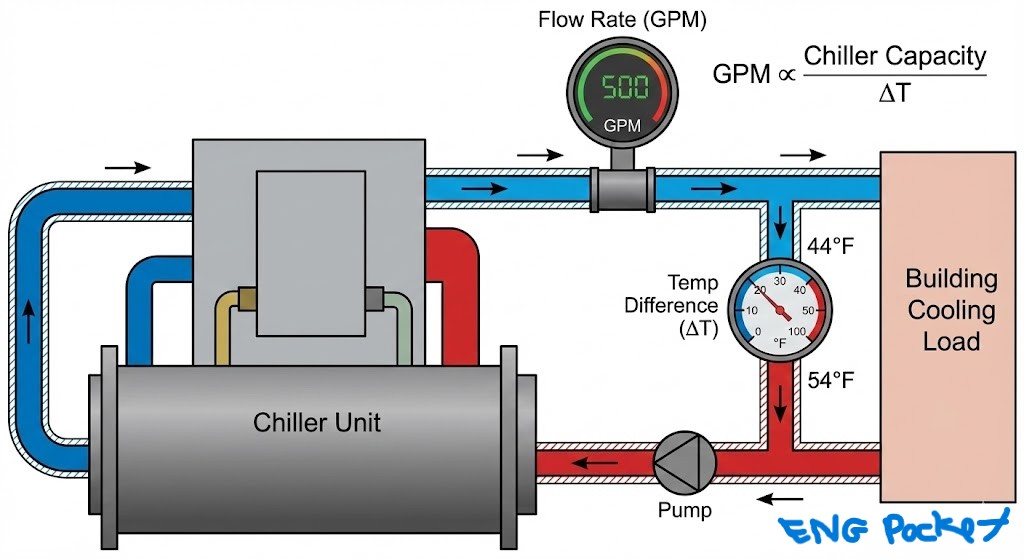
GPM chiller calculation aims to ensure that the volume of water flow is sufficient to carry the cooling load (TR) from the building back to the chiller. If the GPM is too low, the water will not be able to carry enough heat, the result from this situation is the room is still warm or not cool enough as the owner wishes.
Balance Between Flow Rate and Temperature (GPM = (TR × 24) / ΔT)
This chiller calculation maintains the balance between water flow rate and temperature difference (Delta T) to ensure system efficiency.
Chiller calculation formula
GPM = (TR × 24) / ΔT
Case example
Rory is an HVAC engineer, he is designing a chilled water system for a new medicine warehouse building. The mechanical team has selected a 200-ton chiller (TR) to handle the cooling load. Based on the chiller manufacturer’s specifications in their catalogue and standard design practice, the temperature difference (ΔT) between the chilled water supply and return is expected to be 10°F (supply at 44°F, return at 54°F).
Calculate flow rate (in GPM):
GPM = (TR × 24) / ΔT
GPM = (200 × 24) / 10
GPM = 4800 / 10
GPM = 480
The required chilled water flow rate is 480 GPM. Therefore, the primary chilled water pump and associated piping should be designed for a minimum flow rate of 480 GPM.
Let’s forgot about chiller calculation a bit. Now we will inform you to some of leading brand chiller in the world.
The American powerhouses, all about reliability and muscle
American chillers like Trane, Carrier, and York are mostly known as the heavy lifters in the industry. If engpocket friend’s project is a massive skyscraper or a huge critical data center, these are usually your best chiller choice:
- Trane: Known for being very tough. In the field, we often say a Trane chiller is built like a tank. They don’t complain much when the weather gets extreme, and their screw compressors are side known as legendary because they can last for decades if we treat them right.
- Carrier: The pioneers. Their strength lies in their smart brain. Carrier units are often very intuitive to troubleshoot. If something goes wrong, their control systems give use clear clues, which is a lifesaver for a technician in a hurry. So, if engpocket friends want a smart, and up to date technology chiller, Carrier is one of your best options.
- York: These one is the masters of variable speed. They have a specific vibe of being very smooth. When a York centrifugal chiller ramps up, it sounds more like a jet engine than a machine, and they are exceptionally good at saving energy cost when the building isn’t run at full capacity.
The European made, all about precision and quiet power
European brands like Climaveneta (Mitsubishi Electric) or Airedale bring a different specification. They focus heavily on the finesse of the engineering.
- Climaveneta: These are the experts in silent cooling. If engpocket friends are working on a luxury hotel or a hospital where noise must be zero, Climaveneta is often the winner.
- Airedale: They are specialized in high precision environments. They don’t just give you a standard box, it feels like the unit was designed specifically for your ducting and your flow rate.
Now that you already know how do chiller calculation, we wonder if you are interested in calculating BTU to PK for air conditioner on this link? Or eager to try our free plugin to automatically draw ductings and their fittings on this link?