1 Phase & 3 Phase Breaker Size Calculator
⚡ Master MCB Calculator
Accurately Calculate Ampacity (1-Phase & 3-Phase)
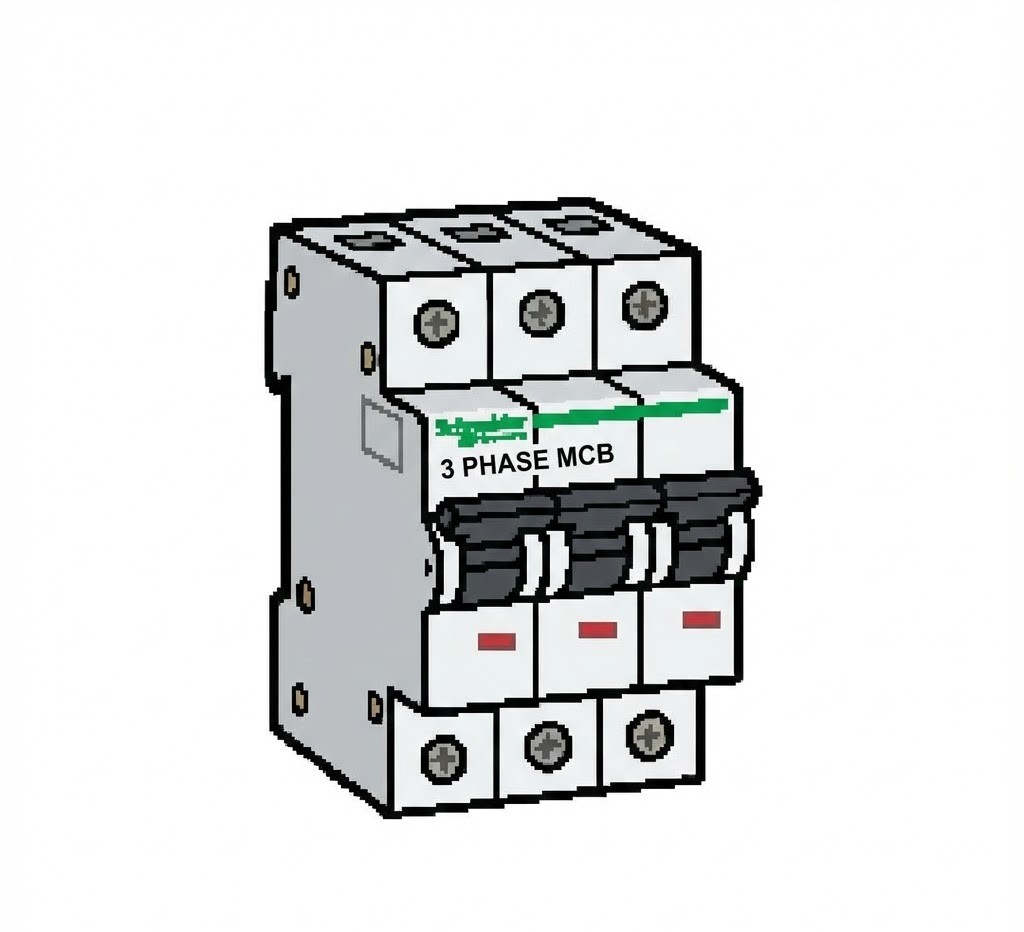
What is a 3 Phase MCB?
A 3 Phase MCB is a triple-pole electrical safety device designed for synchronized operation. If a fault, such as a short circuit or overload occurs on even just one of the phases, all three poles will trip simultaneously.
In layman’s terms, the breaker will ‘pop’ or ‘flip down’ together to cut off the entire power supply for maximum safety.
What is a 1 Phase MCB?
A Single-Phase MCB, frequently referred to as a 1 Pole MCB, is an automatic safety breaker specifically engineered to interrupt electrical flow in single-phase systems, such as the standard 220V residential utility grid
The Key Differences: 1 Phase vs. 3 Phase MCB
In contrast to the standard single-phase MCB typically found in residential homes, a 3 Phase MCB is specifically engineered for high-capacity power demands.
It is the primary choice for commercial shophouses, office complexes, industrial plants, factories, high-rise buildings, and even high-end luxury estates with significant electrical loads.
Why Use 380V and 220V Systems?
A 1 Phase MCB operates on a 220 Volt system, which represents the Phase-to-Neutral voltage. If you measure the potential difference between any single phase conductor (R, S, or T) and the Neutral (N) line, the reading will consistently be 220 Volts.”
“In contrast, a 3 Phase MCB utilizes a 380 Volt system. This 380V value is defined as the Phase-to-Phase (or Line-to-Line) voltage. If you measure the voltage across any two phase conductors, for example, between Phase R and Phase S, the resulting reading will be 380 Volts.
Calculation Formulas for 1-Phase and 3-Phase MCB Ratings
For EngPocket fans who are curious about how the calculator above gets its numbers, this is the engineering “secret sauce.” Calculating the Ampere rating for an MCB relies on basic electrical power formulas, with slight differences between 1-Phase and 3-Phase systems.
For standard residential electricity, the calculation is straightforward. We simply divide the total power (VA) by the standard voltage, which is 220 Volts.
*Example: 1300 VA residential power.
Current = 1300 ÷ 220 = 5.9 Amps. (Therefore, use a 6A MCB).
For industrial or large-scale business power, the system uses 3 phase wires. Therefore, the voltage (380 Volts) must first be multiplied by the Square Root of 3 (√3 = 1.732). This calculation results in the “magic number” 658.
*Example: 10,500 VA commercial shophouse.
Current = 10,500 ÷ 658 = 15.95 Amps. (Therefore, use a 16A 3-Pole MCB).
The results from the formulas above are “Exact Current” values. In the field, you won’t find MCBs with decimal ratings like 5.9A or 15.95A. You must round these numbers up to match the standard MCB sizes available on the market (such as 2A, 4A, 6A, 10A, 16A, 20A, etc.).
Practical Case Studies: Calculating MCB Ratings
The Danger of a Reversed Phase Sequence
“In a 1 phase system, accidentally swapping the live and neutral wires might still allow an appliance to turn on (even though it compromises safety). However, in the 3 phase world, the installation sequence of the R, S, and T cables is absolutely non-negotiable, especially if your load consists of electric motors, water pumps, or central AC compressors.
If the cable sequence is reversed (for instance, swapping Phase R with Phase S), the electric motor will rotate in the opposite direction. Just imagine a scroll compressor in a commercial building’s AC spinning backward; equipment worth tens of millions could be destroyed in a matter of seconds, or a water pump that is supposed to suction might end up blowing instead.
This is exactly why Engpocket technicians always rely on a phase sequence indicator or rotation tester before powering up any 3 phase machinery for the very first time.
Non-Negotiable Wire Color Codes
Because of the sheer number of cables involved, maintaining strict wire color discipline in both 1-phase and 3-phase installations is absolutely critical for life safety. In accordance with the latest PUIL (General Requirements for Electrical Installations) standards in Indonesia, you cannot simply use a single color—like black—randomly for all your wiring.
The commonly accepted color standards are:
- Phase R (L1): Red (old standard) or Brown (new standard).
- Phase S (L2): Yellow (old standard) or Black (new standard).
- Phase T (L3): Black (old standard) or Grey (new standard).
- Neutral (N): Strictly Blue.
- Grounding (PE): Strictly Yellow-Green.
If you carelessly color-code your wiring, future technicians coming in for maintenance could be put in grave danger. Just imagine if a technician assumes a blue wire is the neutral line, but you have actually wired it as a live phase. A standard 220V electronic device could explode instantly because it was suddenly hit with a 380V current.
Definition & Calculator of Voltage Drop and Breaker Capacity
Voltage Drop is the reduction in electrical potential that occurs along the conductor cable. The longer the cable distance and the higher the current flow, will affecting to more voltage decrease at the end of the line.
Meanwhile, Breaker Capacity is the rating of a circuit breaker (MCB / MCCB) designed to trip and disconnect the current in the event of an electrical overload or a short circuit.