Calculus calculator derivatives and integrals
Helooo Engpocket friends, if you are an engineer, you must know that nothing stays static. Temperatures fluctuate, changing speeds, or structures vibrate. How to understand these changes? We can use calculus! Whether to analyze cooling rate of an HVAC system or the stress on a pipe.
To help you calculate calculus faster, this calculus calculator helps you compute the rate of change (Derivative) and the accumulation of quantities (Integral).
Function Visualizer
Derivative & Integral Evaluator
Use standard math notation like: x^2, sin(x), or 2*x
f(x) = …
Derivative (Slope) ≈ …
Area (Integral from 0 to x) ≈ …
Calculus formulas
What is calculus?
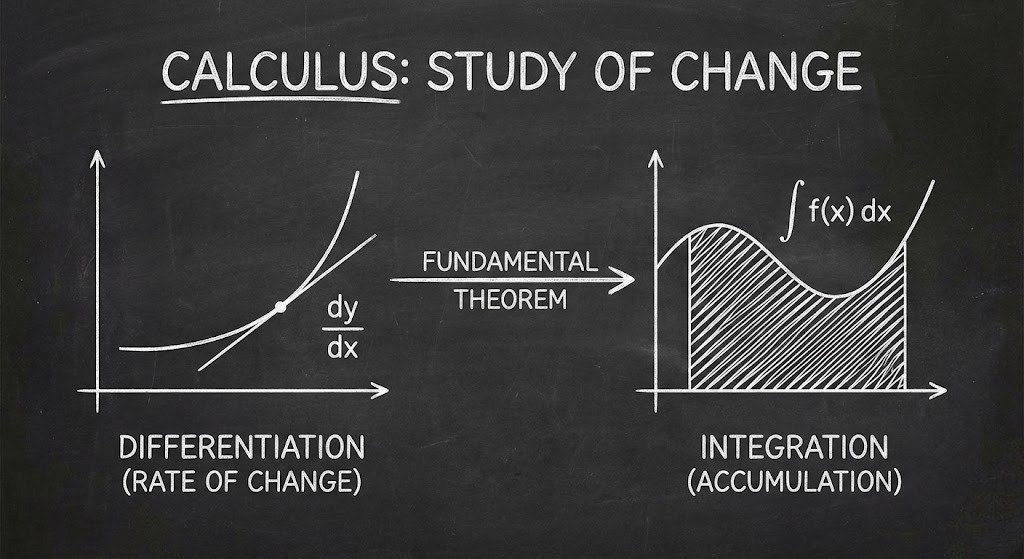
Calculus is math study of continuous change. It is divided into two types:
- Differential calculus (Derivatives): Measures how instantly something changes, for example how fast a car is moving at a specific second.
- Integral Calculus (Integrals): Measures accumulation, for example the total distance walked or how much a volume of a water tank.
As engineers, we also use calculus to calculate something like:
A. Calculating the rate of heat loss through a wall over time (Derivative) to choose an Aircon capacity.
B. Determining the bending moment of a beam (Integral of the shear force).
C. Calculating voltage across a capacitor based on the current flow (Integral).
Example case of calculus
This is the example of manual calculus calculating. You can also try the calculus calculator to make sure that both methods were right and the calculus calculator was accurate.
Find the velocity v(t) at t = 3.
Calculate the area from x = 0 to x = 4.
Why we need calculus calculator and the manual concept of it?
Calculus is the bridge between theoretical physics and real-world engineering. While an algebra calculator helps engpocket friends find a fixed point, a calculus calculator allows us to see the movement and the accumulation of forces. In the field, we rarely deal with constant values. If we are designing a drainage system, the rain doesn't fall at a constant rate, it starts slow, peaks, and then tapers off. To find the total volume of water our pipes must handle, we integrate that changing rate over and over again.
Calculus practice case
Part 1: Basic Derivatives (d/dx)
- d/dx(5) = 0
- d/dx(x) = 1
- d/dx(2x) = 2
- d/dx(x^2) = 2x
- d/dx(x^3) = 3x^2
- d/dx(x^4) = 4x^3
- d/dx(x^10) = 10x^9
- d/dx(3x^2) = 6x
- d/dx(5x^3) = 15x^2
- d/dx(10x^5) = 50x^4
- d/dx(x + 2) = 1
- d/dx(x^2 + x) = 2x + 1
- d/dx(4x^2 - 5) = 8x
- d/dx(1/x) = -1/x^2
- d/dx(sqrt(x)) = 1/(2*sqrt(x))
- d/dx(sin(x)) = cos(x)
- d/dx(cos(x)) = -sin(x)
- d/dx(tan(x)) = sec^2(x)
- d/dx(e^x) = e^x
- d/dx(ln(x)) = 1/x
Moving Towards Differential Equations (Advanced Calculus)
The basic understanding of calculus that Engpocket friends, have learned above also serves as a steppingstone towards differential equations. For those of us designing dynamic systems, such as vehicle shock absorbers or chemical reaction rates in a plant, these equations are absolutely essential to predict the behavior of systems that continuously change over time.
This is the end of our calculus calculator post. To use our algebra calculator and find about algebra information deeper, you can visit this link.