Carbon footprint calculator
On this era, sustainability is no longer just a trend, it is a core engineering requirement. With the implementation of global carbon taxes and green building sticker & certifications, understanding the environmental impact of facility operations is critical for every professional engineer and facility manager.
That is why calculating carbon footprint is important and this carbon footprint calculator will help you calculate mote fast
🌿 Carbon Footprint Calculator
*Based on standard factors: Elec (0.85 kg/kWh), Diesel (2.68 kg/L).
What is carbon footprint?
A carbon footprint is the total amount of greenhouse gases, primarily carbon dioxide (CO2), released into the atmosphere as a direct or indirect result of an individual’s, organization’s, or building’s activities. In the MEP scoope of work sectors, the primary sources of carbon emissions are:
- Scope 2 emissions: Indirect emissions from the consumption of purchased electricity.
- Scope 1 emissions: Direct emissions from on-site fuel combustion (example diesel generators, boilers, or fleet vehicles).
Carbon footprint formula
To calculate the carbon footprint, we use emission factors (EF). These factors is the amount of CO₂ produced per unit of energy consumed.
- Emissions from Electricity Consumption:
E_elec = kWh × EF_grid
What we know:
- E_elec = Total emissions from electricity (kg CO₂)
- kWh = Kilowatt-hour of electricity used
- EF_grid = Grid emission factor (approximately 0.85 kg CO₂/kWh)
- Emissions from fuel (Diesel/Genset):
E_fuel = L × EF_fuel
What we know:
- E_fuel = Total emissions from fuel (kg CO₂)
- L = Volume of fuel in liters
- EF_fuel = Fuel Emission Factor (approximately 2.68 kg CO₂/liter)
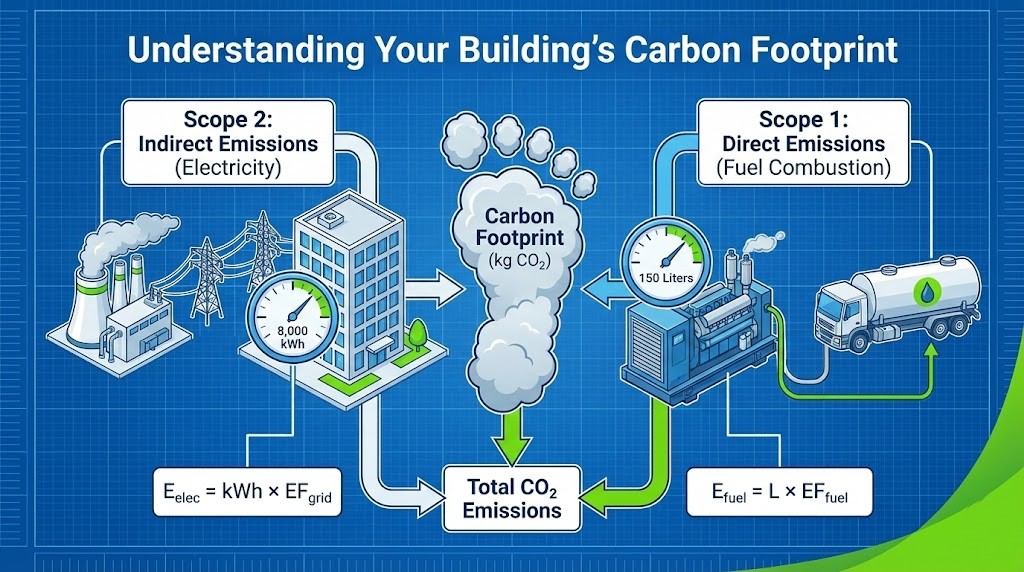
Carbon footprint calculation example
You can check the answer using carbon footprint calculator too.
An office building consumes 8,000 kWh of electricity per month and uses 150 liters of diesel for its backup generator. Calculate the total monthly carbon footprint.
Step 1: Calculate electricity emissions
E_elec = 8,000 × 0.85 = 6,800 kg CO₂
Step 2: Calculate fuel emissions
E_fuel = 150 × 2.68 = 402 kg CO₂
Total monthly carbon footprint:
Total = 6,800 + 402 = 7,202 kg CO₂ (or 7.2 metric tons)
Visualizing the Invisible Impact
Engpocket friends, after we hit the submit button on our carbon footprint calculator, we might see a result like 7,200 kg of CO2. But because we cannot see gas, that number often feels abstract. Let’s make it real.
Did you know that to neutralize just 1 ton of CO2, we need around 50 mature trees growing for a whole year? So, if our facility produces 7 tons per month, imagine that we need a small forest of 350 trees just to balance out our monthly operations.
Alternatively, that amount of emission is roughly equivalent to driving a standard diesel car without stoping from London to Rome and back. It really puts things into perspective, doesn’t it?
How to lower the score? Does the carbon footprint calculator help?
Don’t just stare at the high number, we can fix it too! As engineers, our job is optimization. If the result from the carbon footprint calculator is too high, we can start with low hanging fruits.
In the MEP sector, the easiest win is retrofitting old lighting with LED motion sensors. Next, check our pumps and AHU fans. Are they running at full speed 24/7?
Installing a VSD (variable speed drive) can cut energy consumption very drastic because a small reduction in motor speed can cause massive energy savings. Small changes in our daily engineering operations will result in a much friendlier number next month.
Operational vs. Embodied Carbon
One final technical note for you, Engpocket friends. The carbon footprint calculator above specifically measures “Operational Carbon”, the emissions from your daily activities like burning diesel or using the air conditioning.
However, in civil engineering and architecture, there is also something called “Embodied Carbon”. This is the carbon footprint trapped in the concrete, steel, and glass used to construct the building itself years ago.
While we cannot change the concrete that is already poured, we can control over the operational carbon. That is why monitoring it monthly using this carbon footprint calculator is the most critical step you can take today for a greener future.
We also have an air change calculator. Feel free to try it on this link.