Cosine calculator
Hello engpocket friends, today we are going to talk about something very mathematics. It is cosine. From architecture to engineering to video game development, cosine function plays a vital role in calculating distances and angles.
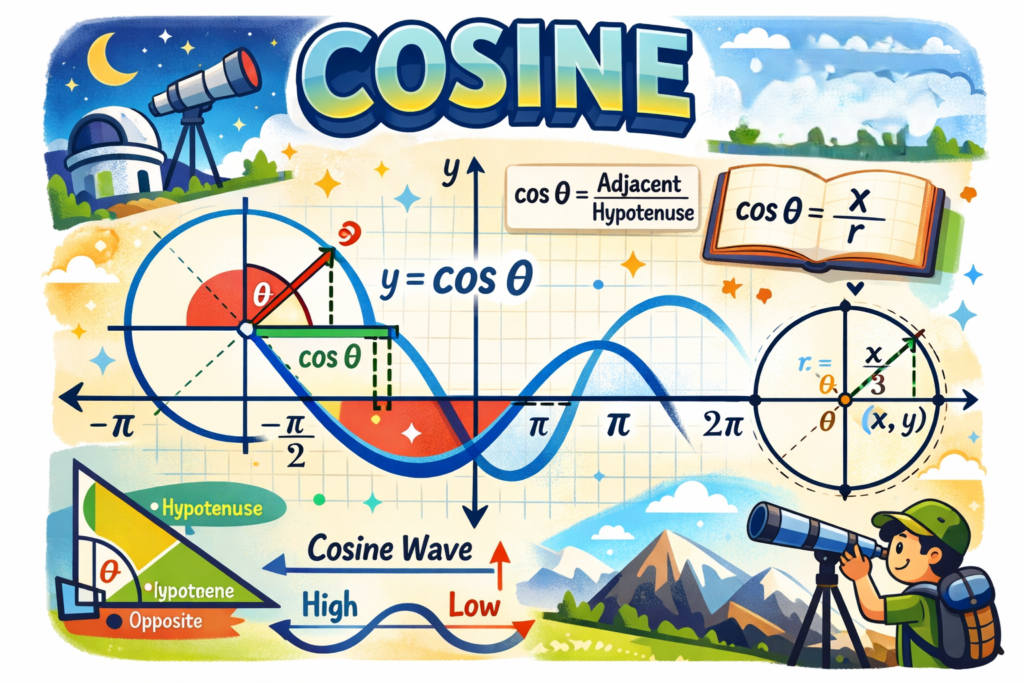
Whether you are a student solving a geometry problem or a professional calculating the slope of a roof, or whatever job you are into, our cosine calculator is here to provide you instant and accurate results.
Cosine Calculator
Calculate cos(θ) in Degrees or Radians
What is cosine?
In a right angled triangle, the cosine (cos) of an angle is the ratio of the length of the adjacent side to the length of the hypotenuse (the longest side).
To memorize this easily, english speakers often use these easy words: SOH CAH TOA.
- SOH: Sine = Opposite / Hypotenuse
- CAH: Cosine = Adjacent / Hypotenuse
- TOA: Tangent = Opposite / Adjacent
The formula of cosine
This cosine formula is the same way as the cosine calculator works
The Cosine Formula
Real world example of cosine calculation
A ladder in my project is leaning against a wall. The ladder is 10 meters long, this one is the hypotenuse). The angle between the ladder and the ground is 60 degrees. How far is the base of the ladder from the wall (adjacent side)? Help me calculate the cosine.
You can try to solve this with our cosine calculator too
Example: Finding the Adjacent Side
Answer: The base of the ladder is 5 meters away from the wall in my project.
Let's practice more about cosine
Practice case A: Calculate the horizontal force (Vector Resolution)
Question: An engineer is designing a guy wire for a utility pole. The wire pulls with a force of 200 Newtons at an angle of 60 degrees relative to the ground. How much is the horizontal pulling force on the pole?
Solution:
Formula: Horizontal Force = Total Force x cos(angle)
Step 1: Identify values. Force = 200 N, Angle = 60 degrees.
Step 2: Find the cosine. cos(60) = 0.5.
Step 3: Calculate 200 x 0.5 = 100.
Answer: The horizontal force is 100 Newtons.
Practice Case B: Roof rafter calculation
Question: A carpenter needs to calculate the horizontal run of a roof rafter. The rafter is 6 meters long and is at an angle of 45 degrees. How wide is the horizontal distance covered by the rafter?
Solution:
Formula: Run = Rafter Length x cos(angle)
Step 1: Identify values. Length = 6 m, Angle = 45 degrees.
Step 2: Find the cosine. cos(45) is approximately 0.7071.
Step 3: Calculate. 6 x 0.7071 = 4.2426.
Answer: The horizontal run is around 4.24 meters.
Practice Case C: Land Surveying, the slope distance
Question: A supervisor measures a slope distance of 50 meters down a hill with an angle of 30 degrees from the horizon. What is the actual horizontal map distance?
Solution:
Formula: Map Distance = Slope Distance x cos(angle)
Step 1: Identify values. Distance = 50 m, Angle = 30 degrees.
Step 2: Find the cosine. cos(30) is approximately 0.866.
Step 3: Calculate. 50 x 0.866 = 43.3.
Answer: The horizontal map distance is 43.3 meters.
Practice Case D: Solar panel efficiency
Question: A solar panel size is 2 meters wide. To maximize the efficiency, it is tilted at 20 degrees. What is the width of the shadow shown by the panel when the sun is directly overhead?
Solution: Formula: Shadow Width = Panel Width x cos(tilt angle)
Step 1: Identify values. Width = 2 m, Angle = 20 degrees.
Step 2: Use the cosine calculator to find cos(20), which is roughly 0.9397.
Step 3: Calculate. 2 x 0.9397 = 1.8794.
Answer: The shadow width is around 1.88 meters.
Practice Case E: CNC Machine Tool Path
Question: A stainless steel cutting tool moves diagonally 100 mm at a 10-degree angle relative to the X-axis. How far did it move along the X-axis?
Solution: Formula: X movement = Total movement x cos(angle)
Step 1: Identify values. Movement = 100 mm, Angle = 10 degrees.
Step 2: Find cos(10) = 0.9848.
Step 3: Calculate. 100 x 0.9848 = 98.48.
Answer: The tool moved 98.48 mm along the X-axis.
We also have a percentage calculator on this link other than this cosine calculator. On the next post, we will give you the sine calculator and we are sure that this will be very useful too. Goodbye and see you.