Water Demand Calculator
Estimating our or customer’s daily water requirement is the first step in designing an excellent plumbing system. Whether you are sizing a ground water tank (GWT), a roof tank, or selecting a transfer pump, you must determine the total daily water demand first.
This water demand calculator uses standard consumption rates based on building type and occupancy to provide an estimate for your project or your needs.
Water Demand Calculator
How to Use the Water Demand Calculator
- Select type of the building: Different buildings (Offices, Houses, Hotels) have different consumption rates.
- Number of occupants: Enter how many people will be using the facility.
- Safety Factor: Add a 10-20% margin to account for peak usage or leaks.
What is the Meaning of Water Demand?
In the world of plumbing design, water demand is basically our building’s daily water budget. It represents the total amount of water needed to keep everything running smoothly for a full 24 hours.
This calculation covers all basic human routines, like taking showers, flushing toilets, and drinking, while also packing in a smart safety buffer to handle sudden usage spikes or unexpected leaks.
Water Demand Formula
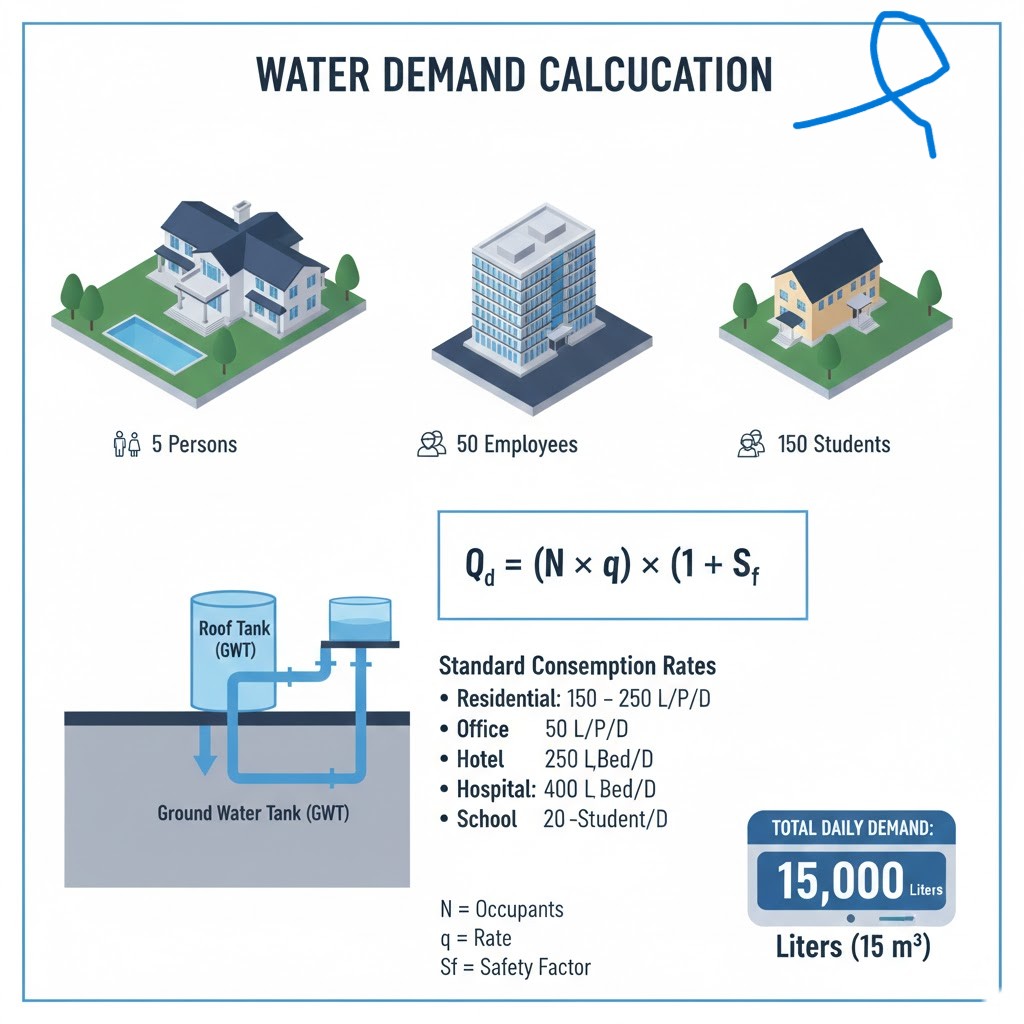
Here is the formula you can use to calculate water demand and the Reference of standard consumption rates
💧 Water Demand Formula
Reference of standard consumption rates:
- Residential (House): 150 – 250 Liters/Person/Day
- Office: 50 Liters/Person/Day
- Hotel (Star-rated): 250 Liters/Bed/Day
- Hospital: 250 – 500 Liters/Bed/Day
- School: 15 – 30 Liters/Student/Day
Example of Water Demand Calculation
A residential complex has 10 luxury houses. Each house is estimated to have 5 residents.
Calculate the total daily water demand with a 20% safety factor. You can double check the answer using the water demand calculator.
📝 Steps and Calculation
The total daily water demand for the complex is 15,000 liters (15 cubic meters).
Difference Between Daily Demand and Peak Flow
Engpocket friends, there is one common mistake that people often make after using this water demand calculator. They use the total daily demand result to determine the size of the plumbing pipes or the transfer pump flow rate. This is totally wrong.
The result we get from the calculator above (for example, 15,000 Liters) is purely a storage volume. It tells us how much water we need to store in our ground water tank (GWT) or roof tank to survive for 24 hours.
It does not tell us how fast the water needs to flow when everyone takes a shower at 7 AM.
For pipe sizing and pump selection, we need to calculate the peak flow using fixture units (WSFU), which has a different calculation entirely. Maybe that can be our next post. Keep this distinction in mind.
Sizing Our Ground Water Tank (GWT) and Roof Tank
What should we do with the number from our water demand calculator? We use it to size our tanks. In standard plumbing design, we do not just put all the water in one place.
A common engineering practice is to split the storage. Usually, the ground water tank (GWT) is designed to hold 100% of the total daily demand (plus fire reserve if applicable).
Meanwhile, the roof tank is typically sized at 30% to 40% of the daily demand.
Why do we not make the tank as big as possible? Bigger is better, right?
The answer is, not really and not always, Engpocket friends. If we oversize our tank significantly (for example, storing 5 days’ worth of water for a small house), the water becomes stagnant.
The chlorine from the city water will evaporate, and bacteria might start to grow. Stick to the calculator’s result to keep our water fresh and our construction cost efficient.
The Reality of Water Saving Fixtures on Daily Demand
As eco-friendly designs become the standard, a common question pops up during the plumbing planning phase.
If a building is fully equipped with high-efficiency toilets, smart faucets, and low-flow shower systems, can we safely reduce our calculated daily water demand?
It is very tempting to simply cut the calculator’s final number by 20 or 30 percent to save space and reduce tank construction costs.
From a field engineering standpoint, doing this is a massive gamble.
Yes, green fixtures are great for shrinking monthly utility bills, but they do not automatically translate to a proportional drop in actual daily water usage.
The unpredictable variable here is human nature. If a low-flow showerhead produces a weak spray, a resident will likely spend twice as much time rinsing off the shampoo. Ultimately, they end up using the exact same volume of water, totally wiping out the expected conservation.
Because of this reality, we should always stick to the standard consumption rates when determining the capacity of our ground water tank. Think of any water saved by those efficient plumbing fixtures as an extra layer of security, not an excuse to build a smaller tank.
Relying strictly on the optimistic numbers printed on a manufacturer’s brochure to downsize your water reserves is asking for trouble.
If the municipal water supply gets cut off for street repairs, a properly sized tank is the only thing standing between a functioning building and a total operational shutdown.