Area of a Rectangle & Perimeter of a Rectangle Calculator
Calculating the area of a rectangle and the perimeter of a rectangle are the most calculating processes that we do in our life. Because rectangle often appears in our daily life. Before we dig in deeper, you can try the calculator first.
📐 Rectangle Calculator
Calculate Area & Perimeter in one click
What Is a Rectangle
A rectangle is a 2 dimensional shape that has 4 sides and 4 corners.
The opposite sides are always having the same length. There are 2 longer sides, which we call length, while the 2 shorter sides are called width.
Area of a Rectangular and Perimeter of a Rectangle Formula
- l Length (m)
- w Width (m)
- A Total Area (Square Units / m²)
- l Length (m)
- w Width (m)
- P Total Perimeter (Linear Units / m)
Sample Case for Area of a Rectangular and Perimeter of a Rectangle Calculation
- Room Area: 3m x 4m = 12 m²
- Single Tile Area: 0.6m x 0.6m = 0.36 m²
- Calculation: 12 / 0.36 = 33.33 pcs
- Rounding Up: 34 Pcs
- Perimeter (P): 40 meters
- Length (l): 12 meters
- Formula: w = (P ÷ 2) - l
- Calculation: (40 ÷ 2) - 12 = 8m
Why Do We Have to Multiply Length and Width while Calculating Area?
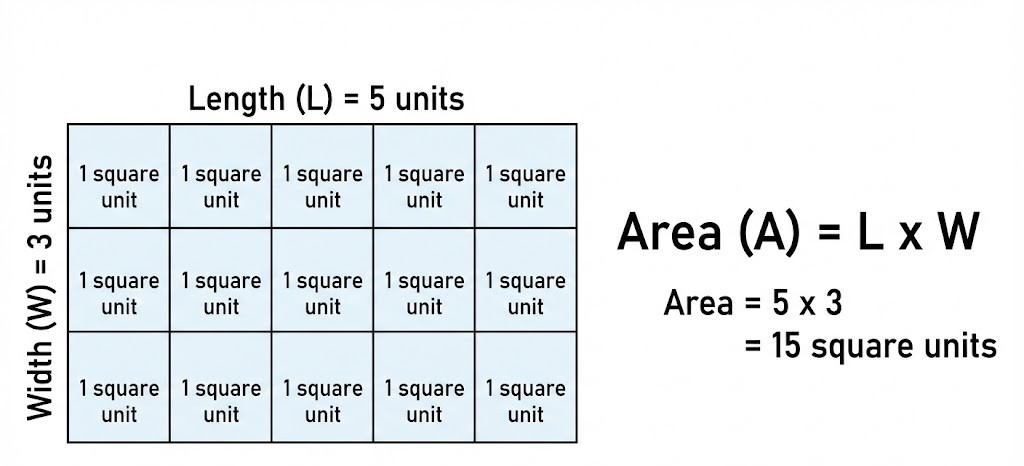
Many people memorize the rectangle area formula without really understanding the logic. Imagine we have a floor measuring 5 meters by 3 meters. Visually, we are actually arranging 5 ceramic boxes (size 1x1 meter) in 3 parallel rows.
The total box we have is 5 + 5 + 5 or 5 x 3, that is, 15 squares. This is the reason why the area of rectangular formula uses the multiplication operation.
We are calculating the total number of squares that can fill the surface we are looking for. This visual understanding is very helpful if we are teaching our children at home so that they do not just memorize formulas without deep understanding.
Understanding Perimeter as a Matter of Distance Traveled
Imagine you are standing at the very corner of a vast rectangular football pitch.
If you were to walk along every single edge of the field until you returned to your starting point, that total distance you covered is precisely what we call the Perimeter.
In the engineering world, the perimeter is often a more crucial figure than any other dimension, particularly when it comes to "containment" or "framing."
We rely on the perimeter to determine the linear meters of fencing required, the length of cabling to be pulled around a room’s interior, or the amount of paint needed for ceiling borders.
In practice, we aren't just filling a space, we are measuring the journey along its boundaries.
List of 50 Rectangular Shaped Objects Around Us
To train our instincts and maybe also if we are teaching our children at home, here is a list of objects whose surfaces use the rectangular area formula in their production calculations:
- Electronic devices: smartphone, tablet, monitor, keyboard, tv remote, laptop, power bank.
- Home furnishings: dining tables, mattresses, pillows, prayer rugs, carpets, mirrors, doors, windows, cabinets.
- Kitchen items: microwave, cutting board, refrigerator (door), oven, tray, tissue box, dish sponge.
- Stationery: notebook, HVS paper, ruler, pencil case, eraser, envelope, brown folder.
- Personal items: atm card, business card, passport, wallet, banknote, photo, stamp.
- Buildings: tiles, bricks, slates, vents, keyholes, street name signs.
- Miscellaneous: flags, chocolate bars, cereal packaging, doormats, bath towels, cinema tickets.