Inverse matrix calculator
Hello Engpocket friends, if you are really up to date with our post, just a couple hours ago we just talked about matrix. Now we are going to talk about inverse matrix calculator. Remember! THIS IS NOT THE SAME WITH THE MATRIX CALCULATOR POST IN THIS LINK. You can spot the difference after digging into this post.
2×2 Inverse Matrix Calculator
Knowing about inverse matrix
Inverse Matrix Concept
Basic Arithmetic Analogy:
In arithmetic, multiplying a number by its reciprocal equals 1.
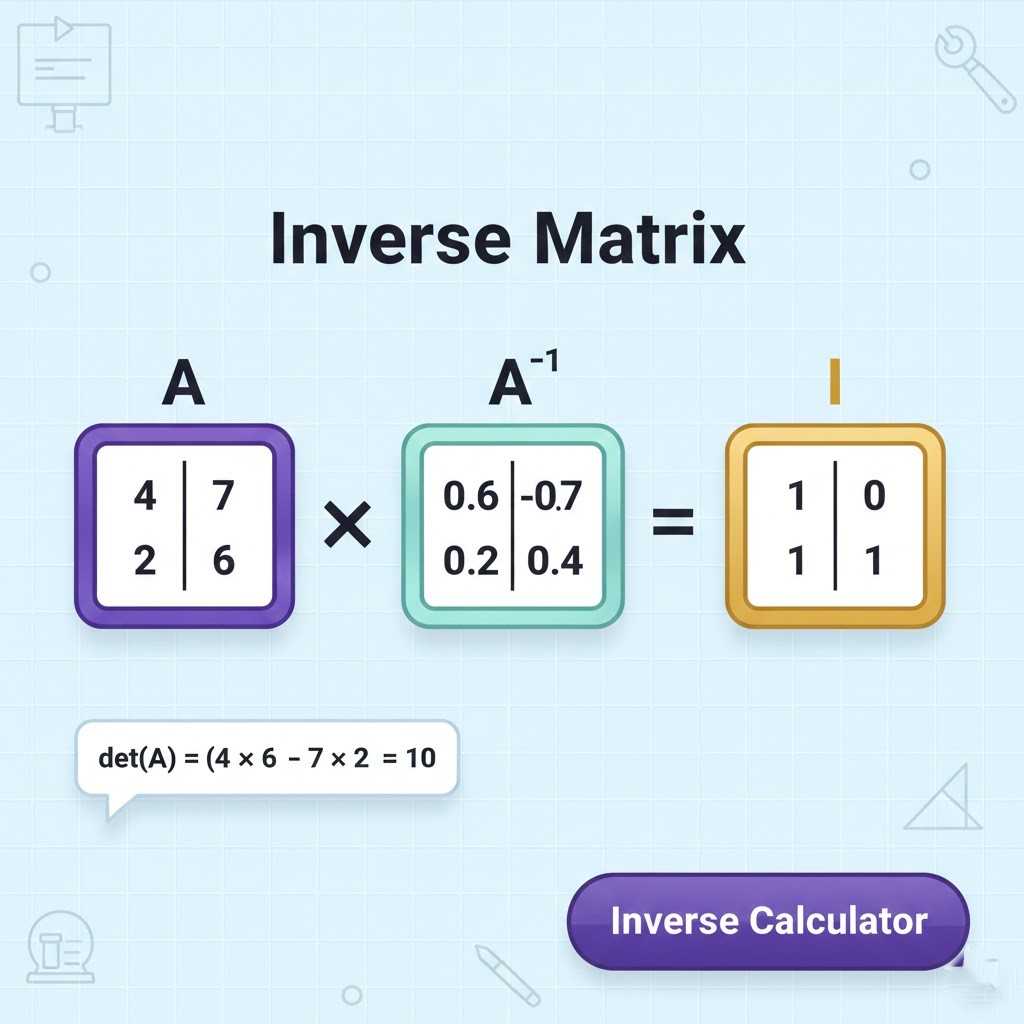
- A: The original square matrix.
- A-1: The Inverse Matrix (the “reciprocal” version).
- I: The Identity Matrix (equivalent to “1” in matrix algebra).
A matrix only has an inverse if its Determinant is not zero. If the determinant is 0, the matrix is called a “Singular Matrix” and cannot be inverted.
We note again. This inverse matrix is not the same with the matrix.
The identity matrix (I)
Before finding an inverse, we must understand the result we are aiming for. An Identity matrix is a square matrix with 1s on the main diagonal and 0s elsewhere.
Can every matrix be inverted?
The answer is NO. For a matrix, to have an inverse, it must have these two criteria:
- It must be square: (for example 2×2 or 3×3).
- It must be non-singular
The 2×2 inverse matrix formula
This formula is the same as the inverse matrix calculator works
Inverse of a 2×2 Matrix
1. Calculate the Determinant:
2. Find the Adjugate Matrix:
- Swap: Positions of a and d.
- Negate: Change signs of b and c.
The inverse exists only if det(A) ≠ 0. If the determinant is zero, the matrix is “singular” and has no inverse.
How to solve an inverse matrix problem?
This is how. You can also use the inverse matrix calculator to test it. But below is the manual formula and calculation.
The Solution: Step-by-Step Inverse
Swap a and d, then change the signs of b and c:
Inverse matrix practice for Engpocket reader
Now that engpocket friends have studied and memorized the formula and the concept of the inverse matrix calculator, it wouldn’t be fair if we didn’t test our skills, right?
Engpocket friends, mathematics is not just about memorizing, it has to be practiced and trained. When we have to get our hands dirty with the numbers to completely understand how the inverse matrix calculator works behind the scenes is the time when we know how exactly to solve the problem in different cases.
Below are 3 exercise problems from easy to advance. we suggest you grab a piece of paper, try to solve them manually first, and then check your answers with the solutions we provide, or you can use our inverse matrix calculator.
PROBLEM 1
Please find the inverse of matrix B:
B =
[ 3 5 ]
[ 1 2 ]
Step to calculate:
First, we have to find the determinant. Remember the cross-multiplication rule (ad – bc).
det(B) = (3 × 2) – (5 × 1)
det(B) = 6 – 5 = 1
We found that the determinant is 1, this is going to be an easy answer.
Now, we must find the adjugate. We swap the positions of 3 and 2, and we flip the signs of 5 and 1.
Adj(B) =
[ 2 -5 ]
[ -1 3 ]
Multiply by 1/det(B). Since 1/1 = 1, the inverse is simply the adjugate itself.
B⁻¹ =
[ 2 -5 ]
[ -1 3 ]
Easy right? O ooow, it is just our warmup.
Let’s go to the next problem
PROBLEM 2:
Now, we are going to deal with negatives.
Ready for the harder one? We will try the matrix C:
C =
[ 4 2 ]
[ 3 -1 ]
Step to calculate:
Step 1: The Determinant. Engpocket friends must be careful with the minus signs here.
det(C) = (4 × -1) – (2 × 3)
det(C) = -4 – 6 = -10
Step 2: The Adjugate. Swap 4 and -1. Change signs of 2 and 3.
Adj(C) =
[ -1 -2 ]
[ -3 4 ]
Step 3: The Inverse formula.
C⁻¹ =
[1 / -10] × [ -1 -2 ]
[ -3 4 ]
Divide every number inside the matrix by -10:
C⁻¹ =
[ 0.1 0.2 ]
[ 0.3 -0.4 ]
PROBLEM 3
This time, there is a trap
We suggested engpocket friends to solve this one before reading the answer. Find the inverse of matrix D:
D =
[ 2 4 ]
[ 3 6 ]
Step to calculate:
Let’s check the determinant first.
det(D) = (2 × 6) – (4 × 3)
det(D) = 12 – 12 = 0
The determinant is 0. Why? Is that normal?
Recall what we discussed earlier in the topic: can every matrix be inverted? Since the formula requires us to divide by the determinant (1/det), and we cannot divide by zero, then this matrix is singular.
The answer for this problem + our conclusion: Matrix D has NO INVERSE. If we tried putting this into our inverse matrix calculator, it would likely give us an error or tell us it is singular.
Always check our determinant first, engpocket friends, it will help you save your time. For this PROBLEM 3, you can try to input it into our inverse matrix calculator to know what the answer is it gives you.
That is all for our inverse matrix calculator post. See you on our next post. Be patient.