Relative humidity calculator & relative humidity formula
Hello engpocket friends! Do any of you work as an HVAC contractor or own an HVAC contractor business? Relative Humidity must be your everyday breakfast, just like for me. In a project, relative humidity is one of the parameters that has to be fulfilled if we want to get the job done.
💧 Relative Humidity Calculator
This is a relative humidity calculator to provide you the smartest way to calculate relative humidity as fast as everybody ever dreamed of.
What is relative humidity?
Relative humidity or can be simplified as RH is a measure of how much water vapor in the air compared to the maximum amount the air could hold at that specific temperature. It is always expressed in a percentage (%) amount.
0% RH: Bone dry air (No moisture at all).
100% RH: Saturated air (the air cannot hold any more water, it starts to rain, fog, or dew forms).
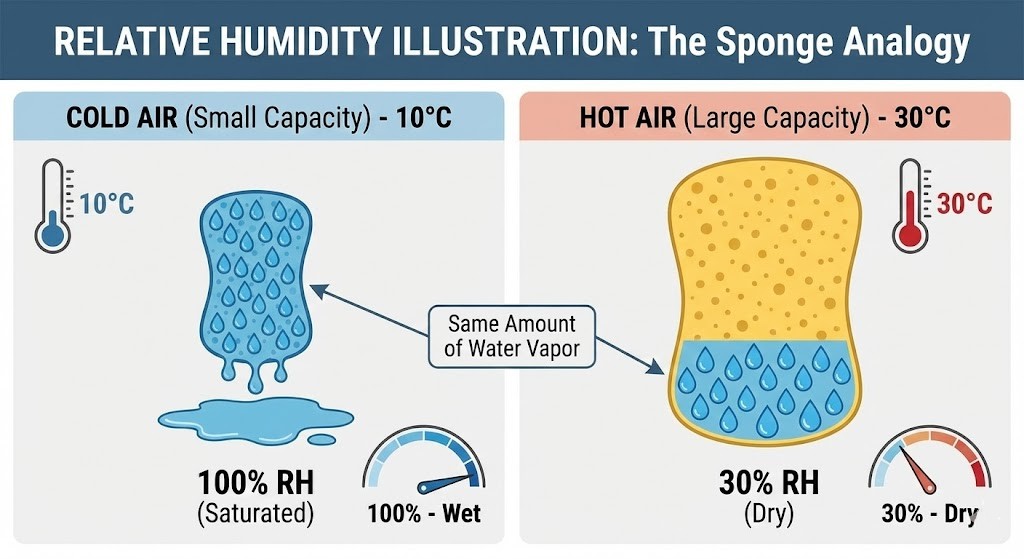
The Sponge analogy (this can help you understand easier)
To visualize RH, imagine the air is a sponge:
A. Hot Air = A Big Sponge. (It has a huge capacity to hold water).
B. Cold Air = A Small Sponge. (It has a small capacity to hold water).
Example 1: If you have a small sponge (Cold Air) that is 100% soaked, and you stretch it into a big sponge (Heat the air), the amount of water stays the same, but the sponge is now only 20% wet.
Result: The air feels dry. This is why heaters make your skin dry in winter.
Example 2: If you have a big sponge (Hot Air) that is 50% wet, and you squeeze it into a small sponge (Cool the air via AC), the sponge becomes 100% soaked and starts dripping water.
Result: This is condensation. This is why Air Conditioners produce water (condensate drain).
Why do we call relative?
We call it relative because it relates to the temperature.
You can have the exact same amount of water in a room, but the RH will change if the temperature changes.
For example:
30°C air with 10g of water = 30% RH (we feel dry).
10°C air with 10g of water = 100% RH (we feel wet/foggy).
Want to know how the relative humidity calculator works? This is the formula
RH=Ps / Pw × 100%
Where:
- = Relative Humidity (%)
- Pw = Actual vapor pressure (tekanan uap aktual)
- Ps = Saturation vapor pressure (tekanan uap jenuh)
Relative humidity chart
As a complement of relative humidity calculator, we can also look at the relative humidity table.
Temperature vs. RH Relationship
What happens if we heat the air but keep water content constant?| Air Temp | Water Capacity (The "Sponge" Size) |
Relative Humidity | Condition |
|---|---|---|---|
| 10°C (50°F) | Low | 100% | 💧 Fog / Dew Point |
| 20°C (68°F) | Medium | ~ 53% | 😊 Comfortable |
| 30°C (86°F) | High | ~ 30% | 🌵 Dry Air |
| 40°C (104°F) | Very High | ~ 18% | 🔥 Very Dry / Arid |
The squeeze effect in HVAC
This is exactly why all air conditioner have a drain pipe. By cooling the air, the air conditioner unit effectively squeezes the sponge in the air (this is just analogy), forcing excess moisture out of the air and into the condensate pan.
Without this process, our room would feel like a sticky sauna. Controlling this squeeze process is the ultimate key to achieving perfect room temperature comfort and preventing mold growth.
We also give you the smartest way to calculate BTU to PK using calculator on this link.
Or you can use our external static pressure calculator to determine your fan needs on this link.