Sine calculator
In the world of trigonometry, sine function is just as fundamental as cosine. Whether you are calculating the height of a building, analyzing sound waves, or working as engineer, understanding how to use the sine ratio is crucial. But this sine is different with the cosine in our previous post.
If you have an angle and need to find the relationship between the opposite side and the hypotenuse, our sine calculator provides the answer as fast as light speed. Let’s try.
Sine Calculator
Calculate sin(θ) in Degrees or Radians
What is sine? Know deeper about sine
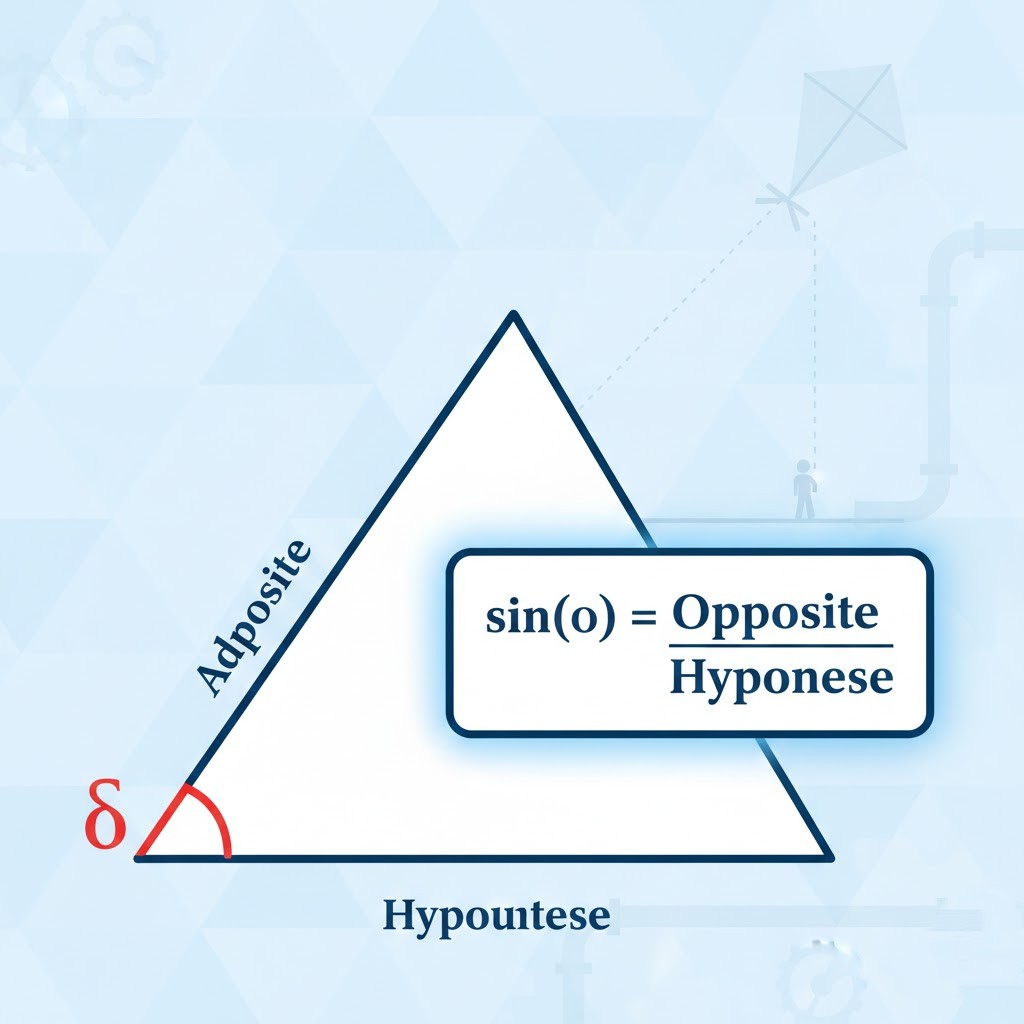
In a right angled triangle, the sine (sin) of an angle is the ratio of the length of the opposite side to the length of the hypotenuse.
Sine formula
The Sine Formula
Key Values to Remember:
| Angle (θ) | Sine Value |
|---|---|
| 0° | 0 |
| 30° | 0.5 (1/2) |
| 45° | 0.707 (1/2√2) |
| 60° | 0.866 (1/2√3) |
| 90° | 1 |
Example of sin calculation
A kite is flying in the air. The string of the kite is 50 meters long (this is the hypotenuse) and makes an angle of 30 degrees with the ground. How high is the kite above the ground? You can also use the sine calculator to solve this problem.
Given:
- Hypotenuse (H) = 50 m
- Angle = 30 degree
We need to find the opposite side.
The Solution: Calculating Height
Substitute the known value: sin(30°) = 0.5
The kite is 25 meters high above the ground.
That is all for the sine post. This is way different from the cosine post because this is a different variable. This is the cosine link and the cosine calculator. Spot the difference.
While our sine calculator is a perfect tool for solving right angled triangles, the real power of the sine function goes far beyond stationary buildings. In the scope of engineering and physics, sine is the fundamental language used to describe motion and energy.
The sine wave, the pulse of engineering
If we work in the electrical or acoustic fields, we don’t just see sine as a side to side ratio, we see it as a wave. Th alternating current (AC) that powers our homes and offices follows a perfect sine wave pattern.
The voltage rises and falls in a smooth, repeating S-curve that allows energy to travel efficiently over long distances.
Whether we are analyzing the rhythmic vibration of a bridge under a heavy load or the sound pressure levels in a recording studio, the sine function explains exactly how that energy swings back and forth. Our sine calculator helps us pinpointing the exact value of these energy waves at any specific moment on the cycle.
The "small angle shortcut
In the structural engineering or fluid dynamics, professionals often deal with very tiny angles, think of the subtle sway of a skyscraper during a windstorm or the slight curve of a long range pipe. There is a famous industry shortcut for these kinds of situations.
When an angle is very small (usually under 15 degrees), the result from a sine calculator is almost exactly the same as the value of the angle itself (when measured in radians).
This allows engineers to make quick, back-of-the-envelope estimations for stability and stress without relying on a computer for every single minor detail. However, once the angle gets larger, this shortcut fails, and we must rely on the precise data provided by a calculator.
Degrees vs radians, the silent project problem
The most frequent mistake when using our sine calculator isn't a lack of knowledge, it is using the wrong unit.
- Degrees: The standard for construction, surveying, and basic geometry. It splits a circle into 360 parts.
- Radians: The standard for physics and rotational motion. It's based on the radius of the circle.
Imagine calculating the slope of a 30 degree ramp for a heavy machinery delivery, but our calculator is accidentally set to radians. The result would be far from correct and precision,it will be leading to a ramp that is too steep for the equipment to climb. Always double check that degree or radians setting before finalize the material orders.