Square Root Calculator & Cube Root Calculator
Hello, EngPocket friends! Today, we’re taking a brief from our usual HVAC, Mechanical, and Civil. Don’t worry, more specialized HVAC and MEP tools are already in the queue for our next update.
However, some calculations are universally vital. Solving square and cube roots mentally is a notorious headache for any engineer without a calculator in hand. That’s why we’ve engineered a streamlined ‘Master Root Calculator’ to handle both instantly. Give it a try on the calculator below before we dive into the theory.
Understanding Square Roots and Cube Roots

Square Roots, Meaning, Engineering Applications
The square root symbol is √. If you’re currently drafting a report or a technical document and need to copy-paste the symbol, feel free to use it from here—I hope this saves you a bit of time!
What exactly is a "Root"? The word "root" on mathematics refers to the origin or foundation of a square. Imagine a square shape: its square root is simply the length of one of its sides.
For example, if a square has an area of 25 square meters, its "root" (the side length) is 5 meters.
Real World & Engineering Applications
Why do we need square roots? In the field or project, this calculation is vital for several core case:
- Geometry: Finding side lengths or diagonals using the Pythagorean Theorem.
- Statistics: Calculating Standard Deviation and variance to measure data accuracy.
- Construction: Ensuring corners are perfectly "square" (90-degree alignment) during site layouts.
- Physics: Determining velocity, acceleration, and the mechanics of free-falling objects.
Cube Roots, Meaning, Engineering Applications
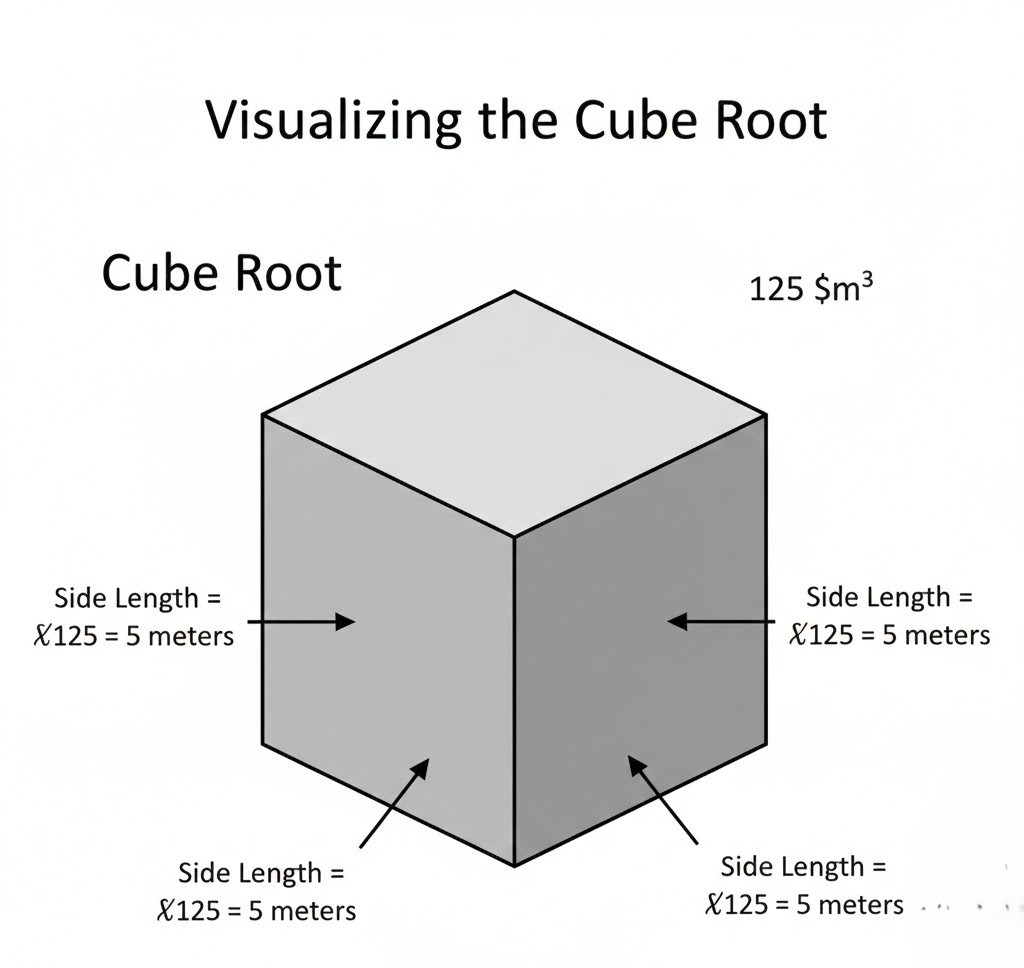
A cube root is the process of finding a specific value that, when multiplied by itself three times, returns the original number.
For instant example, the cube root of 27 is 3, because 3 x 3 x 3 = 27.
The mathematical symbol for the cube root is ∛.
Real World & Engineering Applications
In the real word, we don't just use cube roots for student homework, we use them to solve spatial problems where volume is the primary factor:
- Sizing Water Storage Tanks: Determining the side length of a tank based on its required liter capacity.
- Shipping & Logistics: Estimating the optimal dimensions for packing crates and boxes to maximize cargo space.
- Interior & Furniture Design: Calculating the proportions of 3D objects to ensure they fit perfectly within a room's layout.
- Concrete Compression Testing: Analyzing the structural strength of concrete cube samples in the lab.
Square Roots and Cube Roots Manual Formula
Core Logic: Roots & Powers
Square Roots and Cube Roots Example Case and Problem Solving
Calculate Like a Pro. EngPocket’s Rapid Mental Root Estimation Tricks
The Mental Math Masterclass
Need quick figures during a meeting but no time to pull out a calculator? Master these high-precision estimation shortcuts to tackle non-perfect roots on the fly.
- Example √50: Find the nearest perfect square, which is 49 (root is 7).
- Difference: 50 - 49 = 1.
- Calculation: 7 + (1 / (2 × 7)) = 7 + 0.07 = 7.07.
- Example ∛30: Find the nearest perfect cube, which is 27 (root is 3).
- Difference: 30 - 27 = 3.
- Calculation: 3 + (3 / (3 × 3²)) = 3 + (3 / 27) = 3 + 0.11 = 3.11.