Tangent calculator
While sine and cosine focus on the relationship with the hypotenuse, the tangent function is unique because it connects the two legs of a right triangle directly. This makes it an essential tool for surveyors, architects, and anyone needing to measure heights and distances without ever leaving the ground.
Our tangent calculator will solve your problem easily.
Precision Tangent Calculator
Input your angle to get the Tan ratio instantly.
What is tangent? What is the tangent formula?
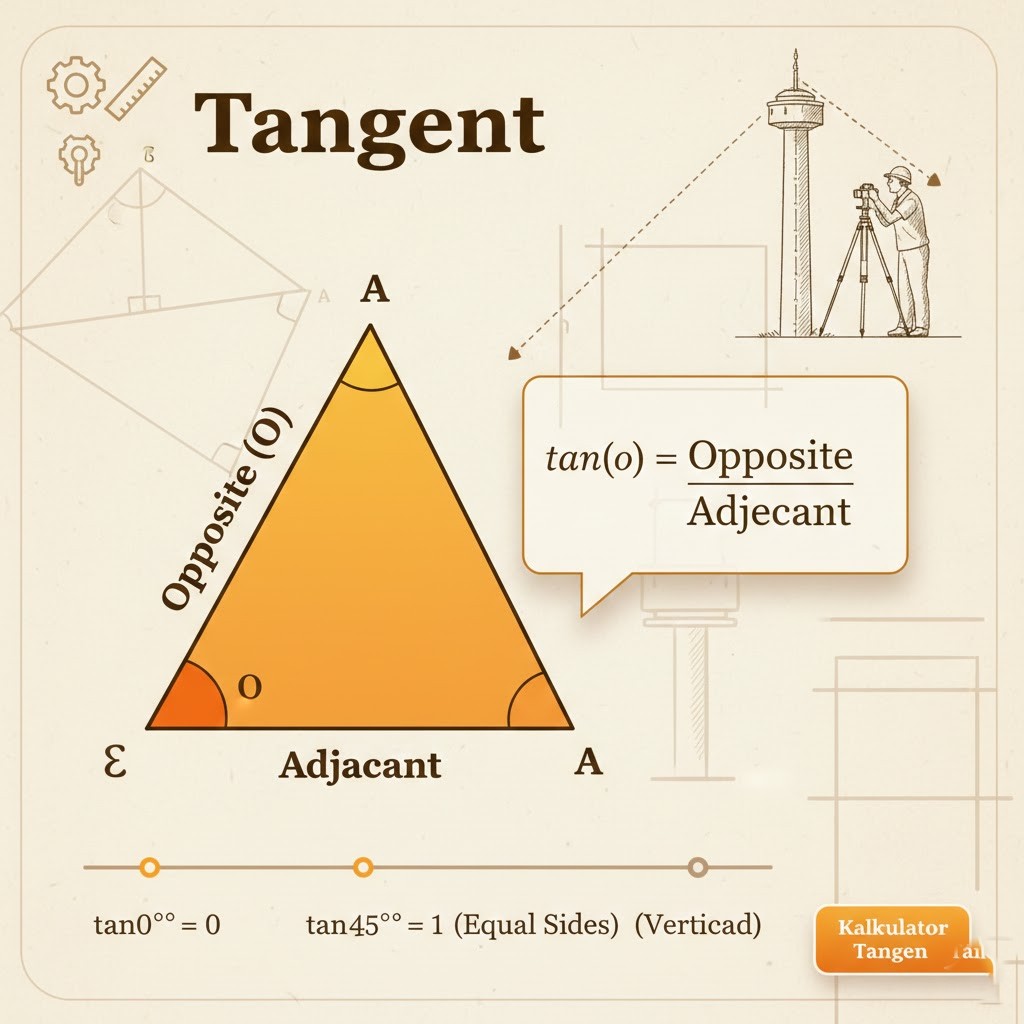
Tangent is the ratio of the opposite side to the adjacent side. It tells you how much the triangle rises for every unit it runs horizontally.
Here is the tangent formula, the same way as the tangent calculator works
The Tangent Formula
Special Properties to Know:
At a 45-degree angle, the height (Opposite) is exactly equal to the horizontal distance (Adjacent).
At 90 degrees, the Adjacent side becomes zero. Since division by zero is impossible, the result is undefined.
Step by step solving the tangent problem
Imagine of this, i am a surveyor trying to find the height of a tower.
I stand 30 meters away from a tower. I use a clinometer to find the angle to the top of the tower is 60 degrees. How high is the tower?
We can calculate it manually or calculate it using the tangent calculator.
Adjacent Distance (A) = 30 meters
Angle = 60 degrees
And we must find the opposite side
The Solution: Finding Height
For a 60° angle, the tangent value is:
The total height of the object is 51.96 meters.
Answer: The tower stands approximately 51.96 meters tall.
Why is tangent being one of the key functions for calculating slope or gradient?
In civil engineering and architecture, the tangent function appears much more often in real-world applications than sine or cosine. This is because tangent does not require the hypotenuse, the slanted side of a triangle, which is often difficult and not possible to measure directly on construction sites. When calculating the slope of a road, drainage channel, or wheelchair ramp, we only need two easily obtainable measurements which is the horizontal distance (Δx) and the vertical rise (Δy).
This concept is known as gradient or slope. Mathematically, gradient (m) is defined as Δy/Δx. Viewed through trigonometry, this relationship is expressed as:
tan(θ) = Δy/Δx = slope (gradient)
This is why tangent calculators are very important tools on site. For example, when designing a drainage channel, engineers must ensure the slope angle allows water to flow smoothly under gravity, without being so steep that it erodes the channel walls.
Application of Tangent in Roof Pitch Calculation
One of the most common questions received by the engpocket team is, "How do you calculate the height of a roof if we only know the building width and roof angle?" Basic area formulas for rectangles or other flat shapes won't solve this, then we must use the tangent function.
Here's how to do it:
- Determine the desired roof angle (e.g., 30° for traditional clay tile roofs).
- Measure half the building width (the horizontal distance from the edge to the centerline).
- Apply the tangent of the angle to compute the truss height:
Height = (½ building width) × tan(θ)
Important note: If the roof angle is 45°, the truss height will be exactly equal to half the building width—because tan (45°) = 1.
Special tangent angles reference table
Even with a precise calculator, memorizing or keeping this reference table will helps speed up discussions with clients or contractors on site:
| Angle (θ) | tan(θ) | Practical Description |
|---|---|---|
| 0° | 0 | Perfectly flat, horizontal surface |
| 30° | ≈ 0.577 | Gentle slope (standard road gradient) |
| 45° | 1 | Perfect diagonal rise |
| 60° | ≈ 1.732 | Very steep incline |
| 90° | Undefined | Perfectly vertical line |
Tangent in triangles vs. tangent lines to circles
An interesting point of confusion arises because the tangent is used in two distinct, but philosophically related mathematical contexts:
- Trigonometric tangent: The ratio of opposite to adjacent sides in a right triangle (as discussed above).
- Tangent line to a circle: A straight line that touches a circle at exactly one point without crossing it.
What is the meaningful connection? A tangent line to a circle is always perpendicular (90°) to the radius at the point of contact. In mechanical engineering, this principle helps determine force direction on rotating wheels or gears. Thus, whether in triangles or circles, tangen consistently describes a precise directional relationship between horizontal and vertical elements at a specific point. Interesting, isn't it?
By understanding this concept deeply, engpocket friends won't just understanding how to use the calculator, but also, you'll grasp the geometric logic behind every structure you design and build.
This tangent is different with the sine and cosine. We also invented the cosine calculator and you can use it for free on this link.