Epoxy Calculator
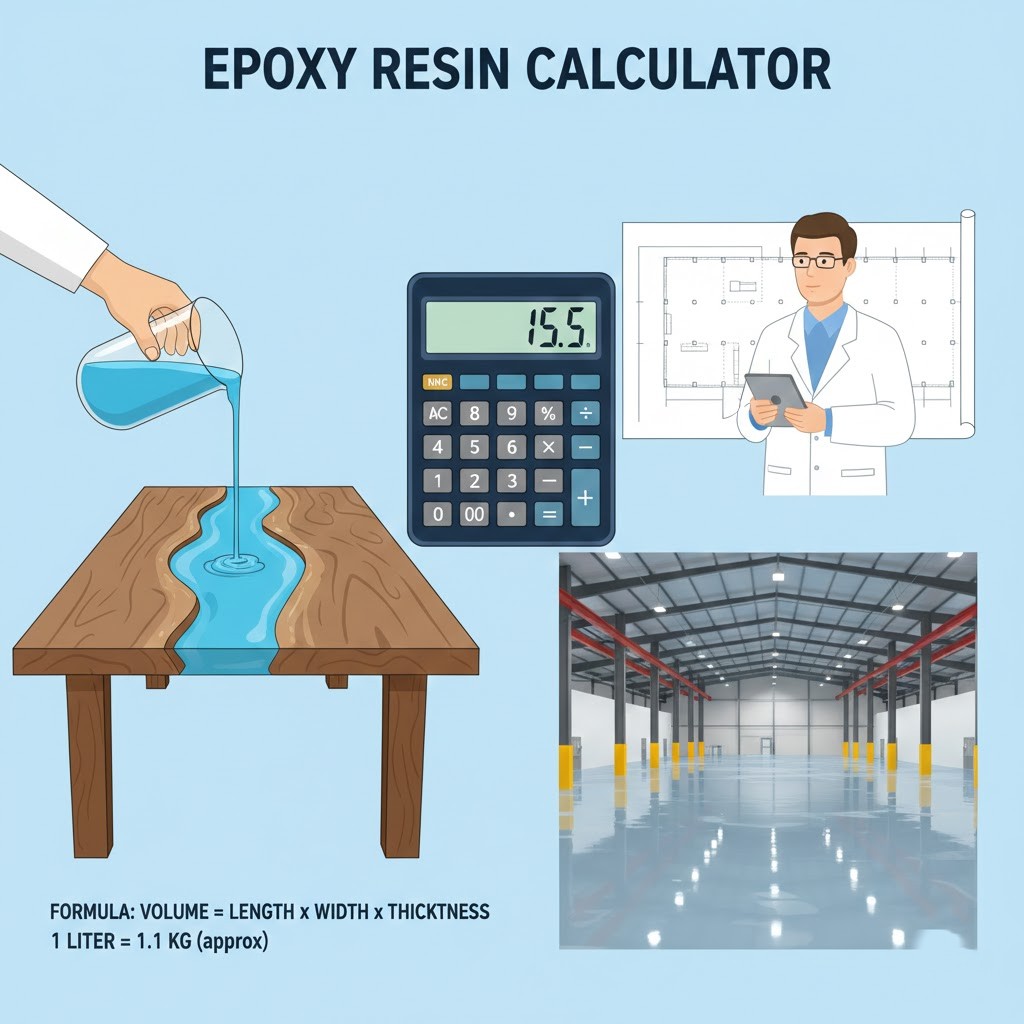
Our epoxy calculator allows engineers, contractors, and DIY enthusiasts to calculate the exact volume of resin and hardener required for any project whether it is to apply a heavy-duty industrial floor coating or maybe building a padel court, futsal court or making your own fishpond.
Epoxy Resin Calculator
Estimate resin volume for rectangular surfaces
Standard coating is usually 1-3 mm. Deep pours can be 10+ mm.
— Liters
— kg (approx)
What is Epoxy?
Epoxy is a polymer formed by the reaction of two parts: a resin and a hardener (thermosetting polymer).
When mixed together, they formed a chemical reaction called curing, transforming from liquid into solid, durable, and chemical-resistant plastic.
In engineering world, it is often used for adhesives, coatings, and composite materials due to its high strength and resistance to degradation.
Epoxy Calculator Formula
This is how to calculate epoxy and the same based formula as the epoxy calculator works
Volume Formula (Thickness)
- V (Volume): Total space or capacity.
- L (Length): The longest side of the object.
- W (Width): The shorter side of the object.
- T (Thickness): The depth or thickness of the material.
Cylindrical Volume
Cylinder Volume Formula (Thickness)
- V (Volume): Total space or capacity.
- π (Pi): Constant (approx. 3.14 or 22/7).
- r (Radius): The distance from the center to the edge of the circle.
- T (Thickness): The depth or thickness of the cylinder.
Volume to Weight Conversion
Volume to Weight Conversion Formula
- Weight (kg): The total mass measured on a scale.
- Volume (L): The space capacity or liter measurement.
- Density: Material mass per unit volume (kg/Liter).
The standard density of mixed epoxy is typically around 1.1 kg/liter. This means that 1 liter of epoxy weighs approximately 1.1 kg.
Case Example of Calculating Epoxy
Epoxy Resin: Volume Calculation Case Studies
We have a table which is 200 cm long, 80 cm wide, and we want to coat it with epoxy at a 0.3 cm coating. How may epoxy do we need?
Result: 4.8 Liters
A warehouse floor is 10 meters by 5 meters, their boss wants to coat the floor with epoxy at thickness of 2 mm
Result: 100 Liters of mixture
The 10% Waste Factor
Pro-Level Logistics: The Buffer Rule
In engineering and professional contracting, we never order exactly the amount shown by the calculator result. Why? Because floors are rarely perfectly level, and mixing containers always retain a small amount of residue.
Always add a 5% to 10% buffer to the result from the epoxy calculator.
Reasoning: It is much cheaper to have half a liter left over than to run out of resin while the floor is mid-cure, which would result in a visible cold joint or seam.
Surface & Absoption
Substrate Porosity: The Sponge Factor
Concrete is like a sponge. If we are applying epoxy to a new concrete warehouse floor, the first primer paint coat will partially soak into the substrate.
May have cracks or divots that consume more volume.
Requires less material due to its dense surface.
Highly absorbent; usually requires a seal coat before the main pour.
Mixing Ratios
The Two-Part System: Resin vs. Hardener
While the epoxy calculator gives us the total volume, remember that epoxy is a two part system. Most industrial epoxies use a 2:1 or 1:1 ratio by volume.
Always check if your specific product requires mixing by volume or by weight. Because the resin always denser than the hardener, 1 liter of resin weighs more than 1 liter of hardener.
Common Mistake: Mixing by weight using volume numbers is a common mistake that leads to tacky or soft spots that never fully cure.