Arc Length Calculator
This arc length calculator provides an instant and accurate way to calculate the distance along a circular arc based on the radius and the central angle.
As an engineer, when designing, we often need to measure lines that aren’t straight. Whether when calculating the amount of steel needed for a curved railing or measuring distance along a circular track, knowing the exact length of a curve is critical.
Arc Length Calculator
2 Ways Calculating Arc Length
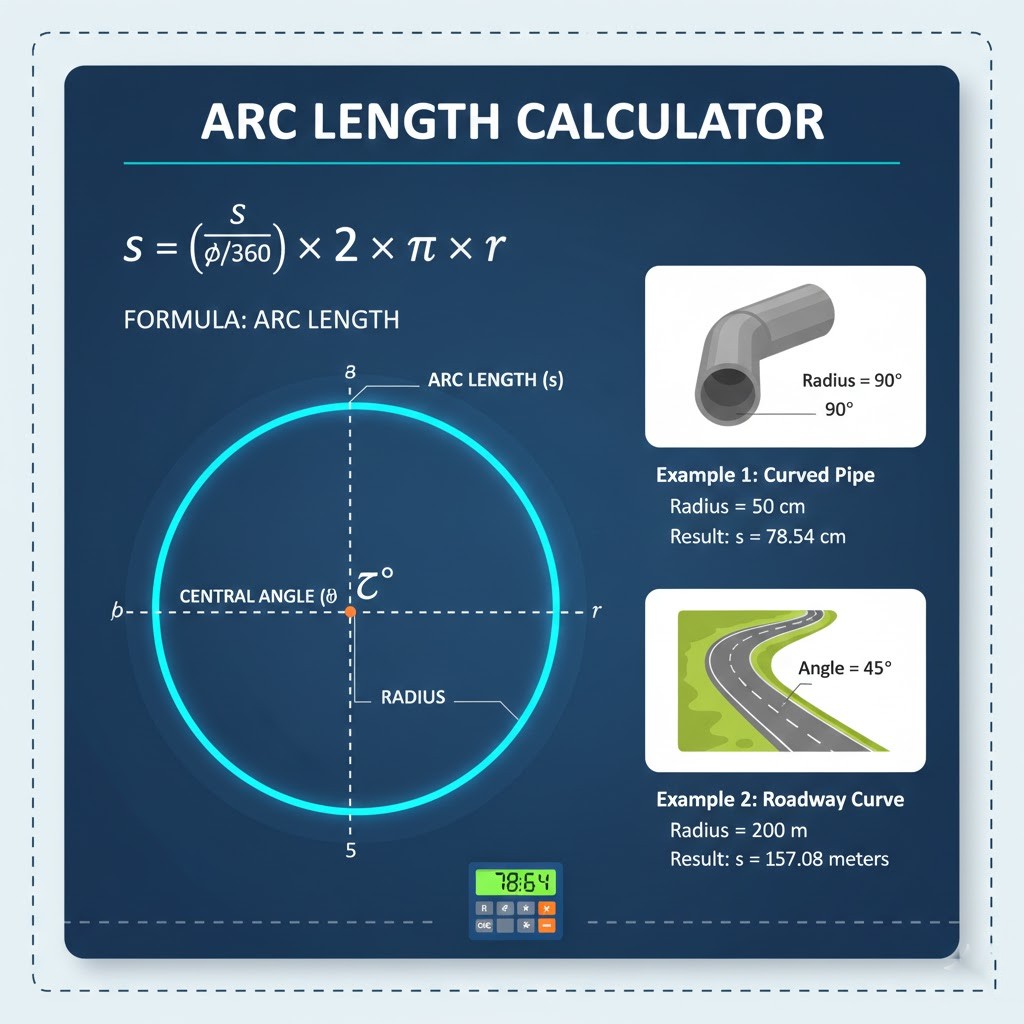
Arc Length: Degrees vs. Radians
• s = Arc Length
• θ = Central Angle (Degrees)
• r = Radius
• θ is measured in radians.
(The preferred, more concise engineering standard)
What is Arc Length?
Arc length is the distance between two points along a curve. In the context of a circle, an arc is a portion of the circumference.
If the circumference represents the full distance around a circle, the arc length represents only some parts of that perimeter, determined by the opening of the central angle.
Example of Calculating Arc Length
Applied Geometry: Arc Length Calculation
1. A pipe has a bend radius of 50 cm and a bend angle of 90 degrees. Calculate the arc length:
Result: 78.54 cm
The arc length of the pipe bend radius is 78.54 cm
2. A circular road curve has a radius of 200 meters and an angular span of 45 degrees. Calculate the arc length:
Result: 157.08 meters
The arc length of the road curve is 157.08 meters.
The Secret of the Neutral Axis in Metal Rolling
The “Ghost Variable”: Neutral Axis in Bending
Using the arc length calculator gives us the geometric length based on a perfect line. However, in the world of metal fabrication, there is a ghost variable that often-causing errors in cutting materials: we call it the neutral axis.
Undergoes Compression (shortening).
Undergoes Tension (stretching).
The neutral axis is an imaginary layer within the plate’s thickness where the length does not change during the bending process. For thin plates, this axis is exactly in the middle (50% of thickness).
However, the thicker the plate or the tighter the bending radius, this axis shifts inward toward the inner radius (often calculated using a K-Factor, typically between 0.33 and 0.45).
Therefore, before we hit the calculate button on our arc length calculator to determine the cut length, please ensure that we have compensated for this neutral axis shift in your radius R input. Without this, your final product might be too short!
Field Measurement Challenges, the Chord Method
Measuring Inaccessible Curves
Imagine standing on a highway construction site or inspecting a massive storage tank. You need to verify the arc length, but the center point is hundreds of meters away or behind a wall. How do you calculate the curve if the radius is unknown?
This is where the relationship between the arc and the chord becomes vital. In the field, measuring curves directly is difficult because tapes can slip or twist. Instead, engineers measure two straight lines.
Chord Length (c)
The straight line between curve ends.
Sagitta (h)
Height from chord center to arc peak.
Using these two physically measurable values, we can apply reverse mathematics to determine the radius (r) before finding the total arc length:
Once you’ve solved for the radius, simply plug the result into your arc length calculator for millimeter-level precision. This technique is what separates a novice drafter from a seasoned field engineer.
Arc Length in CNC Programming (G-Code)
CNC Circular Interpolation & Arc Length
For those who are in modern manufacturing, the concept of arc length is the heartbeat of CNC (Computer Numerical Control) machines. Modern lathes or milling machines don’t see curves like our eyes do; they read coordinate codes.
In G-Code programming, commands rely heavily on arc calculations. The machine needs to know the start point, end point, and the distance to the center.
Why use an arc length calculator?
On a curved path, the cutting speed at the workpiece surface can differ from the motor speed of the axis. Knowing the exact path length helps programmers estimate the production cycle time of a machine part accurately down to the second.
Segmentation
When Curves are Actually Flat
Have you ever noticed that 3D models in AutoCAD software or video games look blocky on their circular parts? In civil engineering and architecture, specifically when creating curved building facades using glass or aluminium cladding, we cannot always create the perfect curve. Glass is flat. Aluminum composite panels (ACP) is flat.
Therefore, the arc length calculator is used to divide the total curve of a building into small straight segments (segmentation).
Here lies the challenge. The total length of 10 flat panels (the sum of chords) will always be shorter than the pure arc length. This difference must be calculated carefully.
If we use the wrong arc length as the total length for flat panels, we will end up with gaps between the panel joints that leak during rain.
Common Unit Errors
Degrees vs. Gradians (gon)
For the last, beware of angle units. Most older surveying tools (Theodolites) or certain european standards use gradiens (gon), where a full circle is 400 grads, not 360 degrees.
90° Right Angle
100 grads (gon)
Calculation Alert:
If we input 100 into a calculator set for degrees, the result will be very far from accurate. Always verify your device settings (DEG vs GRAD) before processing surveying data.