Water Heating Calculator
Hello Engpocket friends, knowing how much energy goes into our heating water is essential. Engpocket’s water heating calculator will help us estimate how long it takes to heat a specific volume of water and how much it costs based on our local electricity rates.
Water Heating Calculator
Estimate heating time and electricity cost.
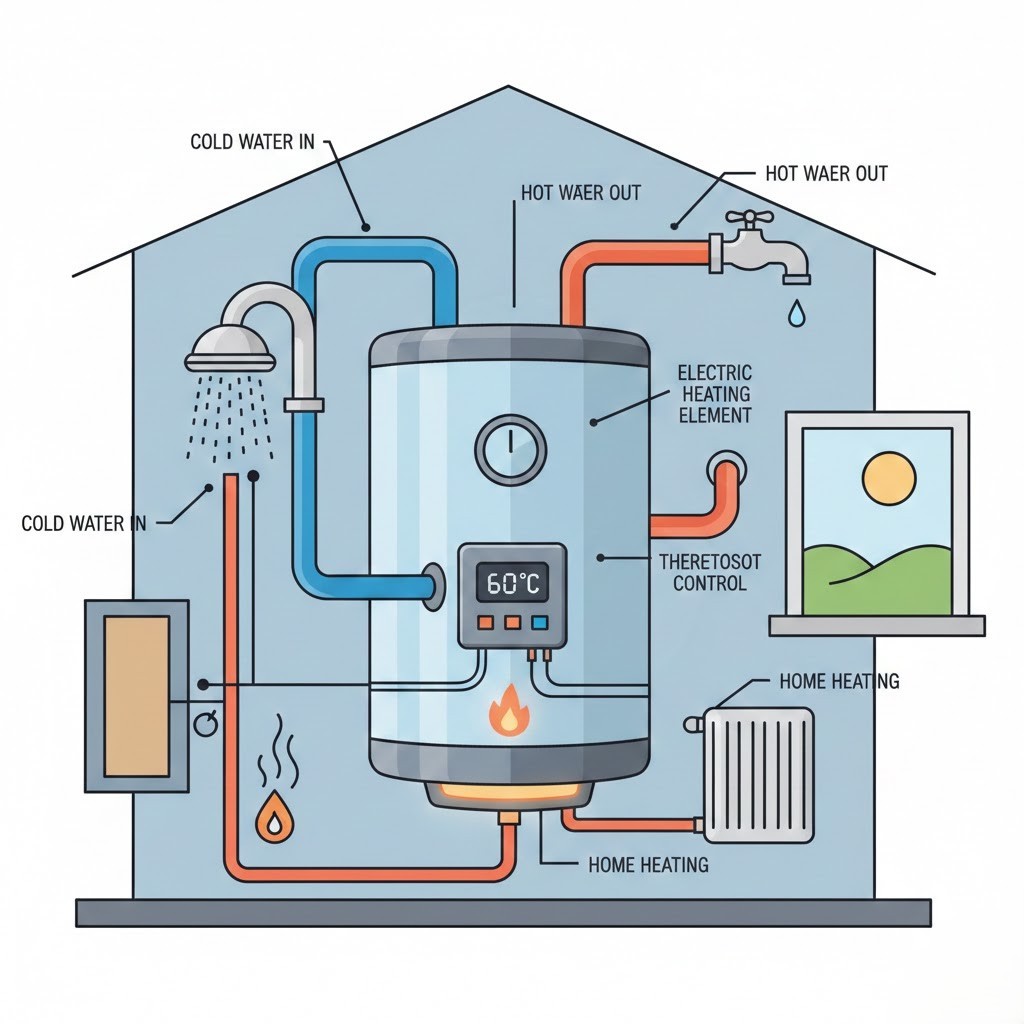
How does Water Heater Work (The Physics)
Thermodynamics: Heating Water
Heating water requires a significant amount of energy.
The specific heat capacity of water is approximately 4,184 joules per kilogram per degree Celsius.
This means it takes 4,184 joules of energy to raise the temperature of 1 liter or 1 kg of water by 1°C.
Water Heating Formula
Thermodynamics Formula
To calculate the time and energy required for water heating, we use the following thermodynamics formula:
Example How to Calculate Water Heating
You can use manual formula or water heating calculator
Water Heating & Energy Analysis
A water heater has a tank capacity of 50 liters (equivalent to 50 kg of water mass) and uses a 1,500 Watt heating element. If the incoming water temperature is 15°C and we want to heat it to a target temperature of 60°C, what is the total energy required, the estimated heating time, and the electricity consumption?
Temperature Difference (ΔT)
Total Energy Required (Q)
Time to Heat (t)
Electricity Consumption (E)
Efficiency and Heat Loss
Efficiency Factors & Real-World Application
While our calculator provides the theory energy required based on the thermodynamics, real life application involves efficiency factors.
Nearly 100% efficient at transferring energy to water.
Often operate between 80% to 95% efficiency due to heat escape through the flue.
Furthermore, we must account for standby heat loss. Once the water reaches the temperature we targeted, heat inevitably escapes through the tank walls into the air.
If your tank is not insulated properly or located in a cold garage, the actual electricity cost will be higher than the calculated value because the heater must keep cycling on and off just to maintain the temperature.
Tank vs Tankless (Instant) Considerations
Storage Tank vs. Tankless Technology
The physics of heating still the same, but the application differs.
The “Time Required” result indicates the recovery rate—how long you must wait for hot water after emptying the tank.
The heating power is the critical variable. Because there is no storage, the heater must apply all that energy instantly as water flows through.
For the last, about safety, always set your target temperature above 60°C (140°F) to prevent legionella bacteria growth, but consider installing a thermostatic mixing valve to prevent scalding at the tap.