Capacitor Bank Calculator
Hello Engpocket friends, have you ever heard about capacitor bank? The capacity of a capacitor bank is measured in kVAR (kilovolt-ampere reactive).
⚡ Capacitor Bank Calculator (kVAR)
Know Deeper About Capacitor Bank
After you use the capacitor bank calculator, do you wonder what is a capacitor bank?
A capacitor bank is a group of several capacitors of the same rating connected in series or parallel to store electrical energy. In industrial power systems, the primary purpose of a capacitor bank is power factor correction (PFC).
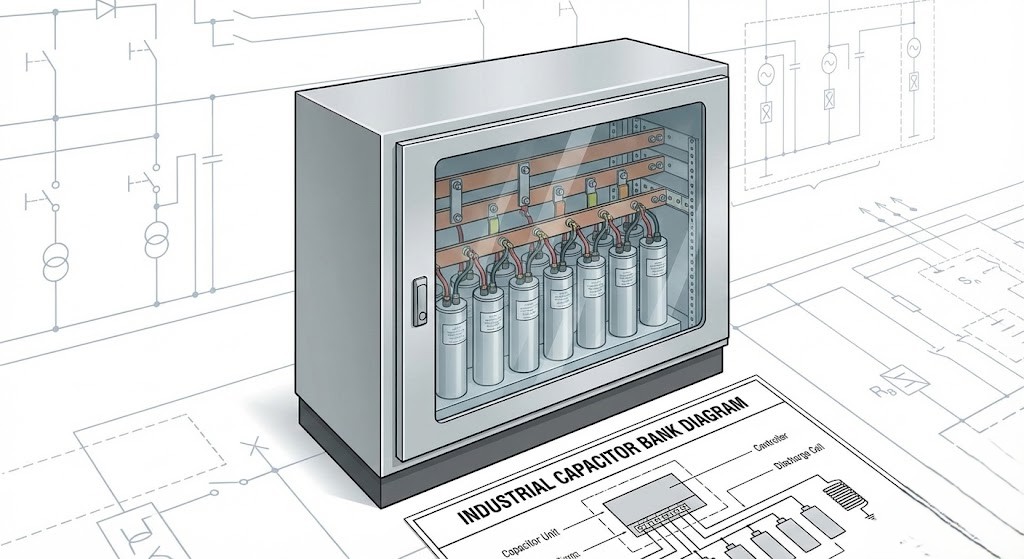
Why We Calculate Capacitor Bank?
We calculate the capacitor bank (Kvar) to determine the exact size of the capacitor needed to raise the power factor from a low value (for example 0.70) to an ideal value (example 0.95 or 0.98). Proper calculation will prevent over correction, which can cause voltage instability.
Capacitor Bank kVAR Formula
⚡ Capacitor Bank Sizing Formula
Use this formula to calculate the required compensation power to improve your system’s Power Factor and reduce reactive energy losses.
- Qc Required Compensation Capacity: Measured in kilovolt-ampere reactive (kVAR).
- P Real Power / Active Load: The actual work-producing power measured in kilowatts (kW).
- φ1 Initial Phase Angle: Derived from the arccos of your current Power Factor (cosφ1).
- φ2 Target Phase Angle: Derived from the arccos of your desired Power Factor (cosφ2).
Case Example of Capacitor Bank Calculation
🏭 Field Case Study: Power Factor Correction
Differences Between Capacitor Bank, Genset and MCB
💡 Basic Electrical Differences
For Engpocket friends who’s just starting career in the field, do not confuse these three:
A genset provides the energy (source).
An MCB protects the system from faults (protector).
A capacitor bank is best described as a power assistant. It does not add new electricity to your building, but instead, it cleans up the existing flow so that less energy is wasted as heat or reactive lag.
Benefits Beyond Avoiding Utility Penalties
⚙️ Internal Technical Benefits of Capacitor Banks
Most engineers use a capacitor bank calculator primarily to stop reactive power fines from utility companies. However, the internal technical benefits are equally valuable:
Improving the power factor reduces the actual current (ampere) flowing through our cables. Lower current means less heat, which prevents the insulation of your wires from degrading over time.
Large inductive loads, such as massive industrial motors, can cause voltage drops. A properly sized capacitor bank helps maintaining stable voltage at the point of use.
By minimizing reactive power, we free up more real power (kW) from your existing transformer. This allows us to add more machinery to our plant without the massive expense of upgrading to a larger transformer.
Standard Capacitor Bank Unit Sizes from Small to Large
Global Brands, from Europe to Asia
🏭 Industrial Capacitor Brand Guide
Once Engpocket friends have determined the capacity through the capacitor bank calculator, your choice of brand will often depend on the project budget and the presence of harmonics in the project system.
Extremely popular for their VarPlus series.
Renowned for their CLMD dry-type capacitors.
A top choice for heavy industrial environments.
Experts in power quality and specialized harmonic filters.
Very common in Southeast Asia due to high reliability.
A global leader in capacitor technology.
Frequently used in large-scale manufacturing plants.
Famous for their user-friendly APFC regulator relays.
A solid choice for commercial projects with tight budgets.