Rectangular Prism Calculator
Hello engpocket friends. As a student, engineer, regular workers, or regular person, rectangular prism is a shape that always present in our lives, everywhere, in any form of things.
Probably as an engineer, a block, a rectangular duct are some of things that have rectangular prism form. Knowing the exact surface area is important for precision. This calculator helps us determine the total external area of any block-shaped object accurately.
Duct Surface Area Calculator
For Insulation & Material Estimation
What is a rectangular prism?
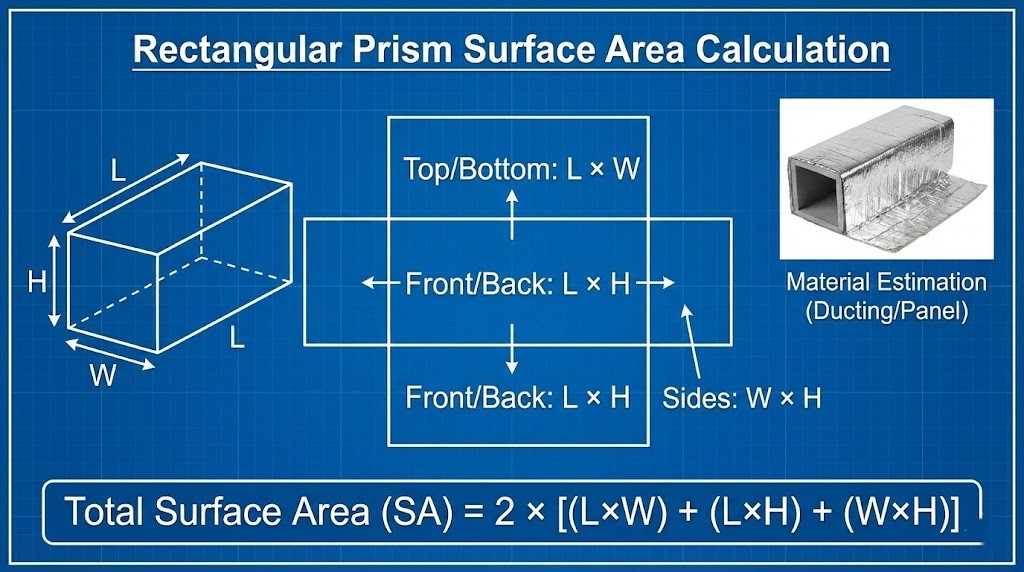
A rectangular prism or sometimes we call it a block, is a three dimension solid shape which has six faces that are all rectangles. In the MEP (Mechanical, Electrical, and Plumbing) industry, this shape is most often seen in:
- Rectangular Ducting: Used for HVAC air distribution.
- Electrical Panels: Housing for breakers and controls.
- Storage Tanks: For water or fuel.
Sometimes in HVAC, MEP or if this rectangular prism used for a duct or a pipe or as a route path that something passes through this rectangular prism, we only calculate the 4 side, not 6.
The Surface Area Formula
To find the total surface area of a rectangular prism, we must calculate the area of all six faces. But in this post, because we are focusing on the HVAC MEP which often use only 4 side, this formula will be calculate only 4 side (excluding both end sides). we calculate the perimeter of the cross-section and multiply it by the total length. But do not worry, our calculator is hybrid, so you can choose whether you want to exclude or include both end sides.
Formula:
Area = 2 × (W + H) × L
Description:
- Area: Lateral Surface Area (m²)
- W (Width): Duct Width (m)
- H (Height): Duct Height (m)
- L (Length): Total Length of the duct run (m)
Calculation Example
An estimator needs to calculate the insulation required for a main supply duct in Engpocket project. What he knows:
- Duct Size: 500 mm (W) × 300 mm (H)
- Length: 10 meters
- Waste Factor: 10%
- Note: Ends are open for connection (so only lateral surface area is considered)
Step 1: Convert dimensions to meters
- W = 500 mm → 0.5 m
- H = 300 mm → 0.3 m
- L = 10 m
Step 2: Calculate lateral surface area
Area = 2 × (W + H) × L
= 2 × (0.5 + 0.3) × 10
= 2 × 0.8 × 10
= 1.6 × 10
= 16 m²
Step 3: Add 10% waste factor
Total Area = 16 + (16 × 0.10)
= 16 + 1.6
= 17.6 m²
Answer: The total insulation material required is 17.6 M2.
Understanding our duct’s surface area isn’t just about ordering the right amount of insulation, it is also about energy performance and cost efficiency. In the HVAC, the surface area directly impacts how much heat is gained or lost as air travels through the system.
The Role of Aspect Ratio
One factor often not seen by estimators is the aspect ratio (the ratio of width to height). For example, a square duct measuring 500 x 500 mm and a very flat rectangular duct measuring 1000 x 250 mm both have the same internal cross-sectional area. However:
- The flat duct has a significantly larger surface area.
- More surface area means you need more material (insulation/cladding).
- It also results in higher friction loss, meaning your fans have to work harder.
External vs. Internal Calculation
When using this rectangular prism calculator, remember that if we are calculating for internal lining (for sound attenuation), the dimensions W and H actually decreased. Conversely, for external cladding (like aluminum sheet jacketing for outdoor ducts), we should add the insulation thickness to our W and H values before calculating to ensure we don’t lack in order material.
We also have an AutoCAD duct drawing plugin, free HVAC ducting CAD blocks & library on this link. This is a very powerful tool. You can enjoy it for free as a compliment of this rectangular prism calculator which is different topic with the free plugin.